


ONETHATCH PALM
Synthetic Palm Thatch
An innovative yet affordable synthetic palm thatch solution, ONETHATCH PALM recreates the natural texture and three-dimensional shape of fan and nipa palm leaves, with enhanced durability and an available fire-retardant version. Also called artificial palm thatch, these palm thatch shingles are moulded from real palm leaves in UV-stabilised HDPE. They stand up to strong sun, heavy rain, pests and everyday wear while keeping their natural look, and carry a 20-year limited warranty.
Variations
Take Your Pick
Give your roof the warmth and texture of natural palm leaves, from a backyard tiki hut or grill bar to an island resort. ONETHATCH PALM synthetic palm thatch shingles are easy to install on tiki bars, outdoor bar roofs, private residences and larger hospitality projects, and matching ridge and hip panels finish the roof. Choose NIPA, FAN or RAINCAPE to create the palm-leaf look that suits your design.
Recreates the natural texture and close-layered look of nipa palm leaf thatching, as seen on roofs across Southeast Asia, for tropical villas, tiki huts and island resort roofs from Bali to the Maldives.
Reproduces the rugged charm and fine detail of natural fan palm leaf thatching, a style used in Panama, Costa Rica and Dominica.
Recreates the woven texture of traditional rain-cape palm thatching for Mexican and Caribbean-inspired palapa roofs.
Gallery
Works
Our engineered thatch roofing materials suit projects of every size, from weekend houses and tiki huts to resorts and tropical villas.

synthetic thatch roofs for resorts
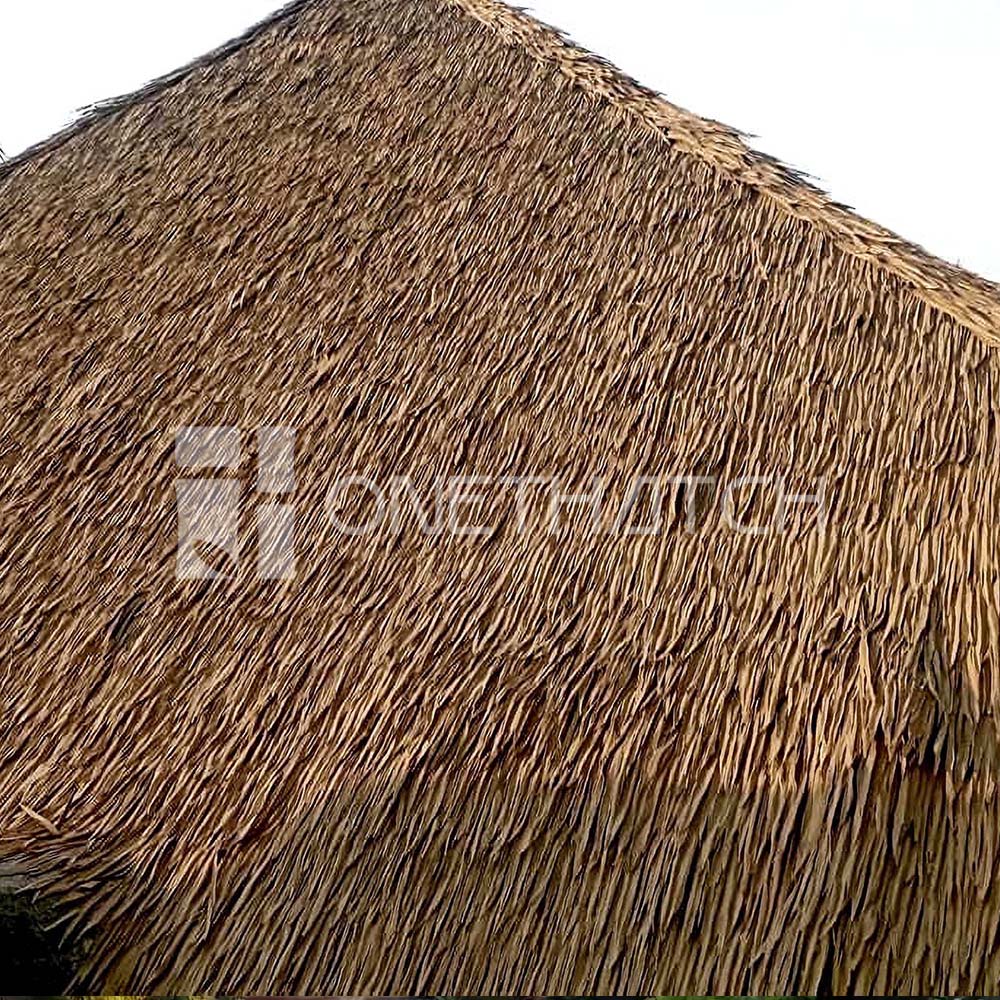
Palapa-style thatch for Cancún and the Riviera Maya

Synthetic thatch roofing for Bali villas

Synthetic nipa thatch for open-air restaurants
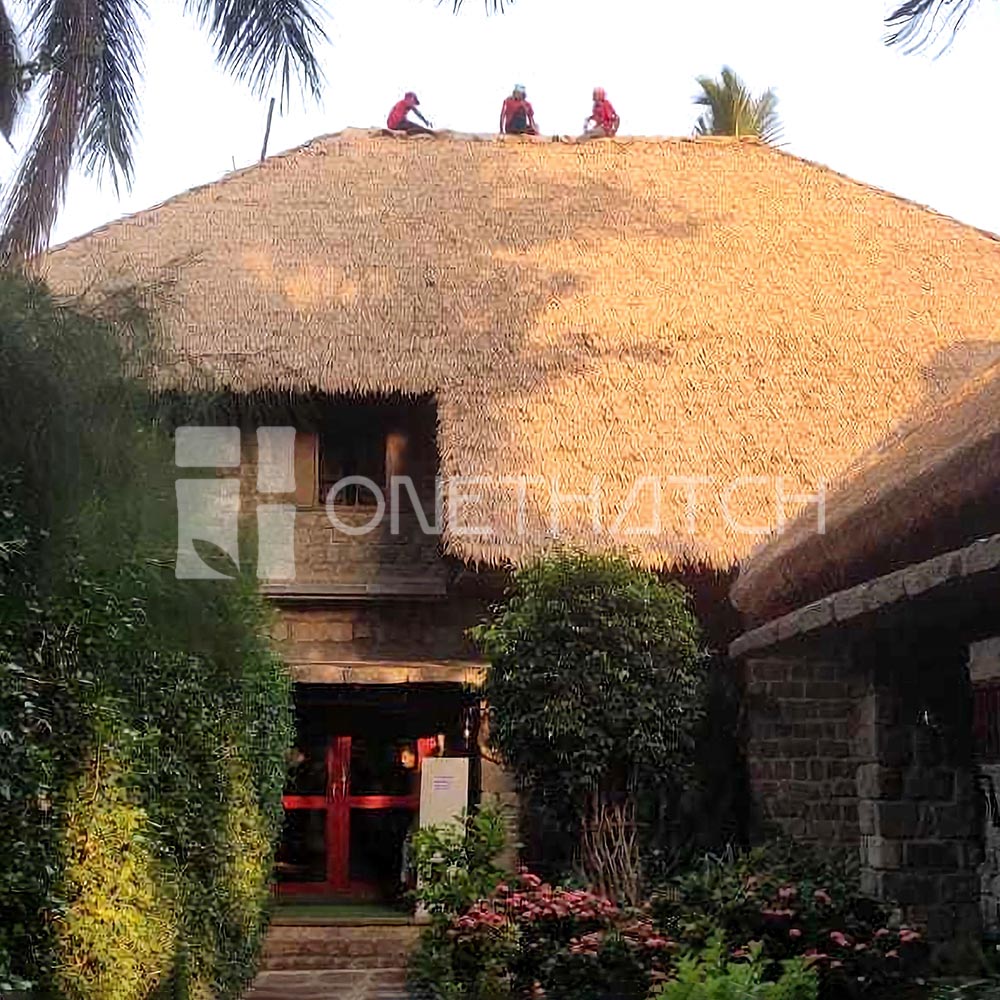
Synthetic thatch for Costa Rica and Panama homes

artificial thatched roofing

Tahitian thatch roofing

Synthetic thatch for Thailand and Sri Lanka resorts
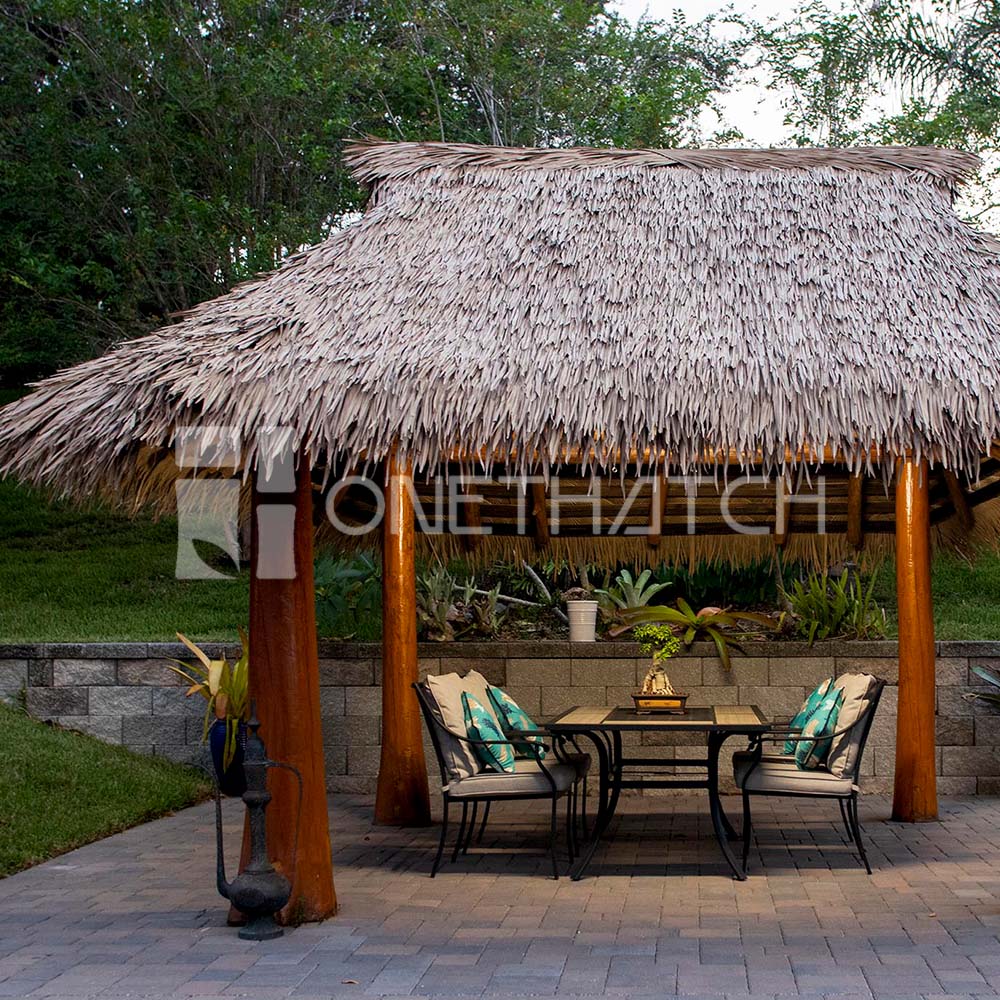
Synthetic Thatch Tiki Hut
Tested
Video
For projects with demanding fire-safety requirements, ONETHATCH synthetic palm thatch is available in a Class A fire-rated version tested to ASTM E108—the highest classification under this U.S. roof-covering fire standard. Click the Play button below to watch our real burn test and see for yourself.
Certified
Warranty
ONETHATCH PALM (NIPA) has been independently tested for fire performance, weathering, wind resistance and wind-driven rain. See the test details below.
Backed by a 20-year limited warranty covering rot, delamination, UV degradation and, in the first 10 years, base-color fading.
01. Fire Retardant
Test: ASTM E108
Tested by: Intertek
Result: The FR version of ONETHATCH PALM achieved Class A to ASTM E108 (Intertek report 220927005SHF-001).
02. Weather Resistant
Test: ASTM G155 (5,000 h)
Tested by: Micom Laboratories (Canada)
Result: ONETHATCH PALM passed with no significant color change.
03. Wind Resistant
Test: ASTM D3161 (fan method); Florida TAS 100
Tested by: PRI Construction Materials Technologies (USA)
Result: ONETHATCH PALM (NIPA) showed no loss of attachment up to 160 mph (260 km/h) and passed TAS 100 wind-driven rain (PRI reports 2756T0002.1 and 2756T0003.1). A lab result, not a site design wind speed.
04. Mold Resistant
Test: ASTM G 21-96
Tested by: Intertek
Result: ONETHATCH NIPA palm thatch shingle resists mold growth, and its HDPE contains no plant material for rot or insects to feed on.
Download
Product Information
ONETHATCH PALM panels measure 980 × 670 mm: approximately 4.9 panels per m² at 220 mm (9 in) course spacing.
Send your roof drawing and pitch for a layout-based quantity calculation, including eaves, hips, ridges and cutting allowances.
For more information, please download the files below or contact us.
Palm Thatch Resources
Specifications, uses, panels, buying and answers, all in one place.
An Artificial Palm Thatch Roof With Real Depth
ONETHATCH PALM gives an artificial palm thatch roof the layered depth of hand-laid leaves. Every panel is moulded from real palm leaves in UV-stabilised HDPE, then backed by test reports for fire, wind, wind-driven rain, weathering and mould, the evidence resorts, architects and palapa builders ask for before they specify a roof.
Choose from three palm styles on one proven system: NIPA for the close-layered nipa roofs of Southeast Asia, FAN for the rugged fan palm look of Central America, and RAINCAPE for the woven rain-cape palapa of Mexico and the Caribbean. All three share the same 980 × 670 mm panel, stainless screw fixing and matching ridge and hip panels, come in an FR version rated Class A to ASTM E108 and carry the same 20-year limited warranty, with free samples so you can see the leaf detail before you order.
ONETHATCH PALM Specifications at a Glance
| Styles | NIPA, FAN and RAINCAPE synthetic palm leaf roofing panels, moulded from real palm leaves |
|---|---|
| Material | UV-stabilised HDPE artificial thatch; PVC-free and 100% recyclable |
| Panel size and coverage | 980 × 670 mm; about 4.9 panels per m² at 220 mm (9 in) course spacing |
| Fixing | Stainless roofing screws through a flexible moulded binder strip into the battens; no solid deck or membrane needed when installed to specification |
| Finishing pieces | Matching ridge and hip panels |
| Fire | FR version: Class A to ASTM E108 (Intertek report 220927005SHF-001). The NFR version carries no fire rating. |
| Wind (tested) | PALM (NIPA): no loss of attachment up to 160 mph (260 km/h), ASTM D3161 (PRI report 2756T0002.1); a laboratory result, not a site design wind speed |
| Wind-driven rain (tested) | PALM (NIPA): passed Florida TAS 100 (PRI report 2756T0003.1) |
| UV weathering | 5,000 h ASTM G155, no significant color change (Micom Laboratories, report MI-25-17428-1) |
| Warranty | 20-year limited warranty on FR and NFR versions |
| Lead time | 3,000 m² in under 7 days; NIPA held in stock |
Panels, Not Rolls
Looking for an artificial palm thatch roll? ONETHATCH PALM comes as 980 × 670 mm moulded panels, also called palm thatch shingles or tiles, each with a flexible binder strip that screws down in a straight course. Rolls and thin plastic palm roof panels tend to lie flat and show their backing; PALM panels are moulded from real leaves and overlap course by course, so the roof keeps the depth and shadow of natural palm, with matching ridge and hip panels for a finished crown.
Synthetic Palm Thatch vs Natural Palm Thatch
Natural palm is beautiful on opening day. The question is how it looks in year three.
Here is synthetic palm thatch vs natural palm thatch, side by side, with the other options buyers often compare.
| Natural palm leaf | Thin plastic palm sheets and rolls | Fibre-style synthetic (ijuk look) | ONETHATCH PALM | |
|---|---|---|---|---|
| Look | Authentic when fresh, then greys and thins | Flat, backing often visible | Dark fibre texture, a different style | Moulded from real NIPA, FAN and rain-cape leaves, with layered depth |
| Upkeep | Re-thatching every few years in the tropics | Replaced when torn or faded | Varies by maker | An occasional rinse, no re-thatching |
| Fire | Dry leaves burn readily | Usually no rating | Ask for the standard and report number | FR version: Class A to ASTM E108 |
| Wind | Leaves loosen and blow off | Often stapled or tied | Ask for the standard and report number | PALM (NIPA): no loss of attachment at 160 mph in ASTM D3161 |
| Mould, rot, insects | Rots and can harbour insects | Varies | Varies | HDPE does not rot; PALM (NIPA) resists mould in ASTM G21 testing |
| Warranty | None | Short or none | Varies | 20-year limited warranty |
What Makes Commercial Grade Palm Thatch?
“Commercial grade” should mean evidence, not adjectives.
Before you specify commercial grade palm thatch for a restaurant, bar, hotel or theme park, ask for five things:
- A fire classification with a report number. ONETHATCH PALM FR: Class A to ASTM E108, Intertek report 220927005SHF-001.
- A wind test. PALM (NIPA): ASTM D3161 at 160 mph (260 km/h), PRI report 2756T0002.1, plus the Florida TAS 100 wind-driven rain test.
- A weathering report. 5,000 hours of ASTM G155 with no significant colour change (Micom MI-25-17428-1).
- A real fixing system. Stainless roofing screws through a moulded binder strip, not staples or ties.
- A written warranty. A 20-year limited warranty on both the FR and NFR versions.
A word on claims that a roof “cannot burn”: no thatch, natural or synthetic, is immune to fire. What you can specify is a tested classification, and that is what the FR version gives you.
Installing Palm Thatch: Panels, Not Bundles
Natural palm is tied by hand. PALM screws down like shingles.
Natural palm leaves are tied to the palapa frame one bundle at a time by a specialist thatcher. PALM panels screw down like shingles, with stainless roofing screws through the binder strip into the battens, so a palapa builder or a handy homeowner can finish a roof with confidence. Installation guidelines come with every order.
Keeping the rain out. Lay PALM on a pitch of at least 18° (about 4:12), at 220 mm (9 in) course spacing, with every panel screwed through its binder strip. Installed to that specification, PALM needs no solid deck or membrane, and PALM (NIPA) passed the Florida TAS 100 wind-driven rain test.
Palm Thatch for Palapas, Tiki Bars and Resorts
Palapas. RAINCAPE is our synthetic Mexican palm thatch: the woven rain-cape texture of a traditional palapa, for beach palapas, palapa umbrellas and poolside palapas from Cancún to the Caribbean. NIPA and FAN suit palapas just as well when you want a neater or a more rugged leaf.
Tiki bars and beach clubs. PALM screws straight onto open battens, so a tiki bar, tiki hut or beach club gets an authentic palm roof without a solid deck underneath. For bars and restaurants, specify the FR version.
Resorts, villas and restaurants. NIPA brings the close-layered nipa roof of Southeast Asia to villas, open-air restaurants and island resort pavilions; FAN gives Central American homes and lodges the fuller look of fan palm thatching.
Palm Leaf Looks from Every Coast
An artificial palm leaf roof should look like it grew on that coast.
PALM gives you three leaves on one system:
- East African makuti. The layered palm-leaf roofs of Zanzibar, Kenya and the Swahili coast, for beach lodges and safari camps.
- Southeast Asian nipa and atap. NIPA’s close-layered leaves for villas, beach clubs and homestays from Vietnam to the Philippines.
- Mexican and Caribbean palapas. RAINCAPE’s woven rain-cape texture and FAN’s rugged fan palm.
Banana-leaf and tropical “leaf” roofs are a popular look too. PALM gives that same lush, leafy silhouette in a panel moulded from real palm leaves, with a fire-rated option and a wind test behind it.
For Commercial Buyers
Buy direct from the synthetic palm thatch manufacturer. We supply synthetic palm thatch wholesale to distributors, contractors, palapa builders and resort projects, and as a synthetic palm thatch supplier shipping to more than 80 countries we send free samples and a quantity take-off from your roof drawings. NIPA is held in stock. For commercial grade palm thatch on restaurants, bars and hotels, specify the FR version, rated Class A to ASTM E108.
What Drives the Cost of a Palm Thatch Roof
A palm roof is priced to its drawing, not to a list.
That is why we do not publish a synthetic palm thatch price per square meter: the same area can need a very different kit. What moves the number:
- Roof shape. Round palapas, cones, hips and long ridges need more ridge and hip panels and more cutting than a simple gable.
- FR or standard. The FR version, rated Class A to ASTM E108, is the one to specify for restaurants, bars and hotels.
- Style and stock. NIPA is held in stock, and 3,000 m² can ship in under 7 days.
- Quantity and destination. A single palapa umbrella and a resort full of pavilions ship very differently.
Where PALM saves money you don’t see on the quote. Installed to specification, PALM screws onto open battens with no solid deck or membrane underneath. That means a lighter frame, fewer materials and a faster build: real savings on a palapa, tiki bar or beach pavilion.
And over the life of the roof. Natural palm leaves cost little to buy, but in the tropics they fade, rot and need re-thatching every few years, with labour every time. PALM has no re-thatching cycle and carries a 20-year limited warranty. It costs more at the start, but because natural thatch needs re-thatching every few years, a synthetic roof usually pays for itself by around year five, and keeps saving every year after.
More roof per container. More than 7,000 m² of PALM ships in one 40-foot high-cube container. Add virtually no upkeep, no closures for re-roofing and 160 mph (260 km/h) wind testing to ASTM D3161, and the higher price per square meter becomes the lower cost per year.
FR costs more up front, with the same savings. The FR version keeps every benefit above and gives your insurer a named fire classification to assess: Class A to ASTM E108, Intertek report 220927005SHF-001.
Prefer the alang-alang look of a Balinese roof? That is our STRAW (BALI) style, quoted the same way, from your drawing.
Tell us what you are building, a single palapa umbrella or a resort full of pavilions. Send your roof drawing or a photo with dimensions, and we will check the panel quantities with your quote and send free samples of NIPA, FAN or RAINCAPE.
Data sheets and guides. Download data sheets, installation guides and limited warranties for every product line on our Technical Resources page.
Synthetic Palm Thatch FAQ
ONETHATCH PALM synthetic palm thatch is moulded in UV-stabilised HDPE from casts of real palm leaves, so each panel keeps the veins and texture of a natural leaf. The material is PVC-free and 100% recyclable, and every style comes in a standard (NFR) version and an FR (fire-retardant) version. It is a low-maintenance alternative to natural thatch, with no re-thatching cycle.
Choose NIPA for a neat, close-layered nipa-leaf roof, as seen across Southeast Asia and on island resorts; FAN for the fuller, rugged look of fan palm thatching from Panama, Costa Rica and Dominica; and RAINCAPE for the woven rain-cape texture of Mexican and Caribbean palapa roofs. See the NIPA, FAN and RAINCAPE product pages, or send us photos of the look you want.
Only the FR version is. The FR version of ONETHATCH PALM is rated Class A to ASTM E108 (Intertek report 220927005SHF-001); the standard NFR version carries no fire rating. Specify FR for restaurants, bars, hotels and any project where the building code or insurer asks for a fire-rated roof covering. Read more about Class A fire-rated thatch for resorts and palapas.
Yes. The palm thatch panels are screwed to the battens with stainless roofing screws, and their flexible binder strip follows round and pitched roof frames. All three PALM styles need no solid deck or membrane when installed to specification. See our tiki hut roof guide and the NIPA installation guide.
ONETHATCH PALM (NIPA) showed no loss of attachment up to 160 mph (260 km/h) in ASTM D3161 testing and passed the Florida TAS 100 wind-driven rain test, both at PRI Construction Materials Technologies. These are laboratory results, not a site design wind speed: the roof frame, battens and fasteners must be designed for local wind loads.
Every ONETHATCH PALM style, FR and NFR, carries a 20-year limited warranty covering rot, delamination, UV degradation and, in the first 10 years, base-color fading. Made for sun, salt air and tropical rain, it passed 5,000 hours of ASTM G155 accelerated weathering (Micom Laboratories, report MI-25-17428-1) with no significant colour change, so the palm-leaf look stays rich and natural season after season. Actual service life depends on climate, exposure and installation; natural palm thatch usually needs re-thatching every few years.
Each 980 × 670 mm ONETHATCH PALM panel screws through its flexible moulded binder strip into the battens with stainless roofing screws. On a roof pitch of at least 18° (about 4:12), lay the courses at 220 mm (9 in) spacing, about 4.9 panels per m², and order around 10% extra for cutting. Matching ridge and hip panels give the roof a clean, finished crown, and all three PALM styles need no solid deck or membrane when installed to specification. Installation guidelines come with every order.
Palm thatch is a roof covering made of overlapping palm leaves, the traditional roof of palapas, nipa huts and island bungalows. Natural palm leaves dry out, rot and need re-thatching every few years. ONETHATCH PALM keeps the same look in UV-stabilised HDPE: NIPA, FAN and RAINCAPE panels moulded from real nipa, fan palm and rain-cape palm leaves, so the roof looks natural from the beach and up close.
For the classic Mexican palapa, choose RAINCAPE, which recreates the woven rain-cape texture of traditional palapa thatching. FAN gives a fuller, more rugged palapa, and NIPA a neat, close-layered one. All three are the same 980 × 670 mm panel, fixed the same way to open battens at a pitch of at least 18°, so you can choose purely on looks. Send us a photo of the roof you have in mind and we will send matching samples.
For most hospitality roofs, yes. Natural palm looks beautiful when new, but in the tropics it fades, rots and needs re-thatching every few years, and it can harbour insects. ONETHATCH PALM kept its colour through 5,000 hours of ASTM G155 accelerated weathering, PALM (NIPA) resists mould in ASTM G21 testing, the roof never needs re-thatching, and every style carries a 20-year limited warranty, so the roof you open with is the roof your guests see years later.
Yes. For commercial grade palm thatch on restaurants, bars, hotels and public buildings, specify the FR version: it is rated Class A to ASTM E108 (Intertek report 220927005SHF-001), the classification many building codes and insurers ask for. Tell us where the project is and we will send the test reports for your permit.
No. We quote every roof from its drawing, because the shape, ridge and hip pieces, the FR option, stock and destination all change the cost. Send us your plans and we will check the quantities with your quote and send free samples.
It is a roof covered with synthetic panels that look like natural palm leaves. ONETHATCH PALM panels are moulded in UV-stabilised HDPE from real nipa, fan and rain-cape palm leaves, then screwed down course by course, so the roof keeps the depth of hand-laid leaves without rotting or re-thatching.
ONETHATCH PALM is made to be a responsible choice. It is PVC-free and 100% recyclable HDPE, and because it has no re-thatching cycle, it spares the repeated harvesting of fresh palm leaves every few years.
Very few. Each panel is fixed with stainless roofing screws through its binder strip into the battens, so a cordless drill-driver does most of the work. No thatching tools or skills are needed, and installation guidelines come with every order.
Pricing
Get A Quote
Large thatching projects can qualify for our factory-direct pricing.
Commercial Buyer?
Looking for installers for your thatch roofing projects? We have thatch roofing installation partners in the US, Brazil, Australia, India, Thailand, Maldives and the Philippines. Contact us for more information.
As the manufacturer and supplier of ONETHATCH synthetic palm thatch, we sell wholesale to distributors, contractors and resort projects from our own ISO 9001 certified factory in Xiamen, China. PALM production of 3,000 m² takes under 7 days, and the NIPA style is held in stock.
Large projects can qualify for factory-direct pricing.
 English
 Japanese
 Arabic
 Spanish
 French
 Portuguese
 Italian
 German
 Chinese (China)
 Thai
 Vietnamese
 Indonesian
 Korean
 Chinese (Taiwan)
 Russian