


ONETHATCH REED
Synthetic Reed Thatch
The richly layered roofs of safari lodges inspired ONETHATCH REED. Our synthetic thatch roofing panels use strands in varied lengths and warm tones to recreate the full, neatly trimmed look of African Cape reed and European water reed thatching. They bring that hand-thatched character to resort villas, lapas and outdoor pavilions: an artificial reed roof with simpler installation and less upkeep than a natural thatch roof.
Variations
Take Your Pick
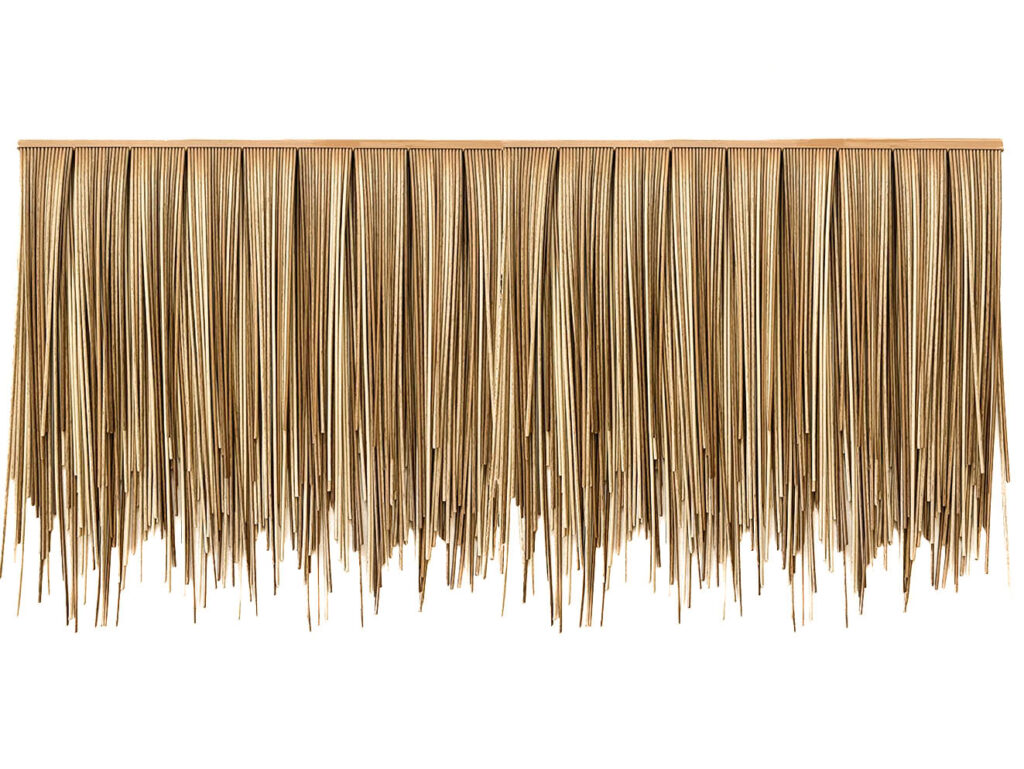
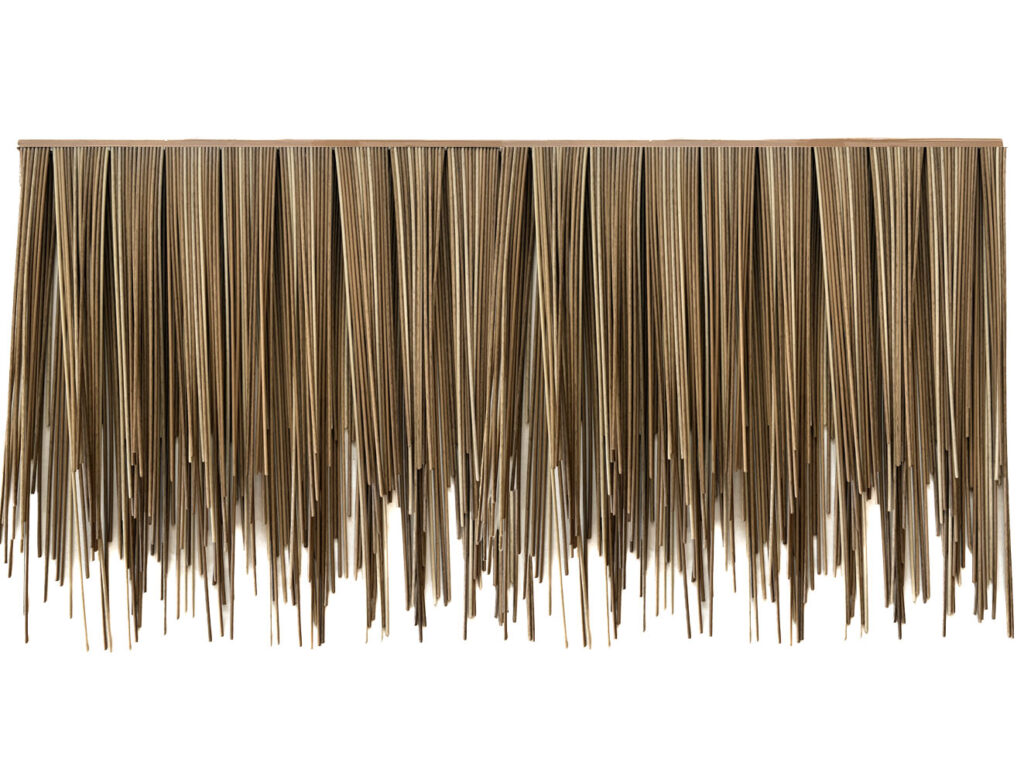
A full, neatly trimmed roof starts with the right mix of texture and colour. Each ONETHATCH REED synthetic reed thatch panel combines strands of varied lengths and tones, creating the depth of natural reed thatching as the panels overlap.
Complete Solution
Parts
Carry the reed texture from the roof edge to the ridge. The ONETHATCH synthetic reed thatch system includes eave, starter, field, and hip and ridge panels, with a piece for each part of the roof.

01. Eave Panel

02. Starter Panel

03. Field Panel

04. Hip & Ridge Panel
Gallery
Works
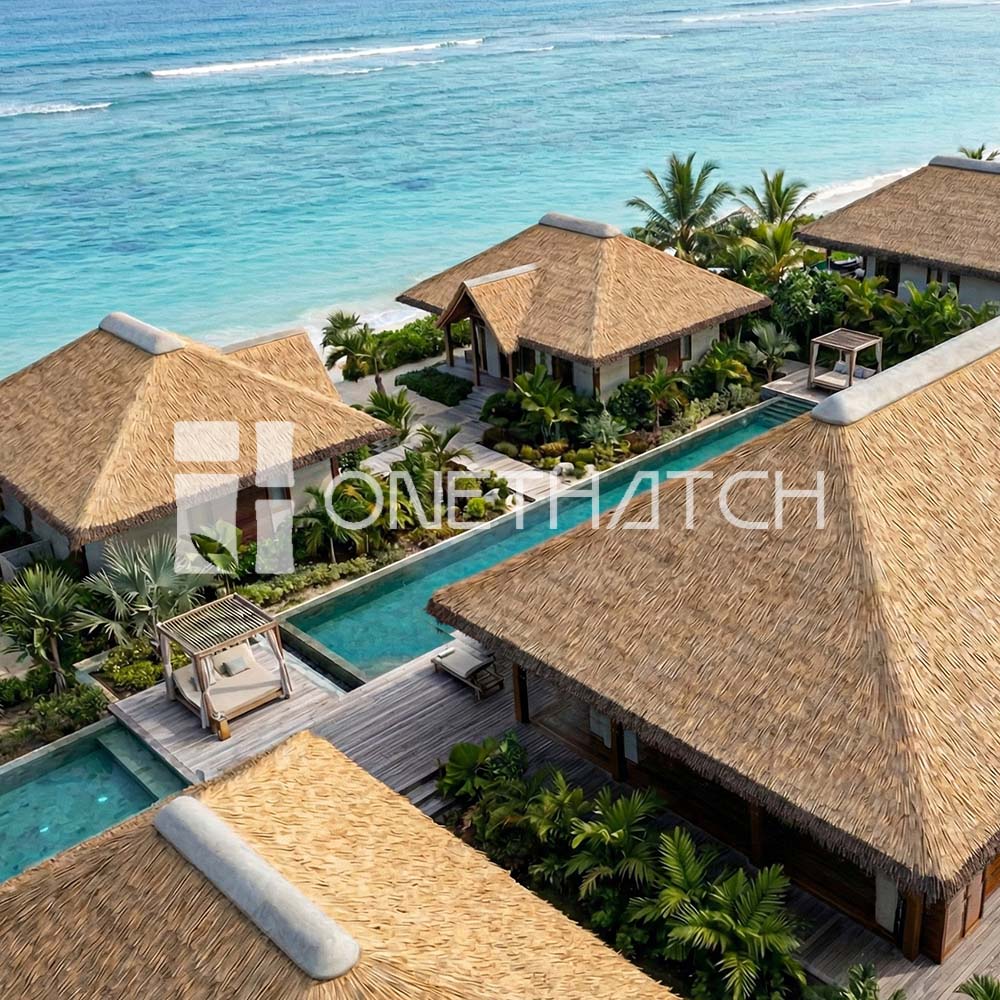
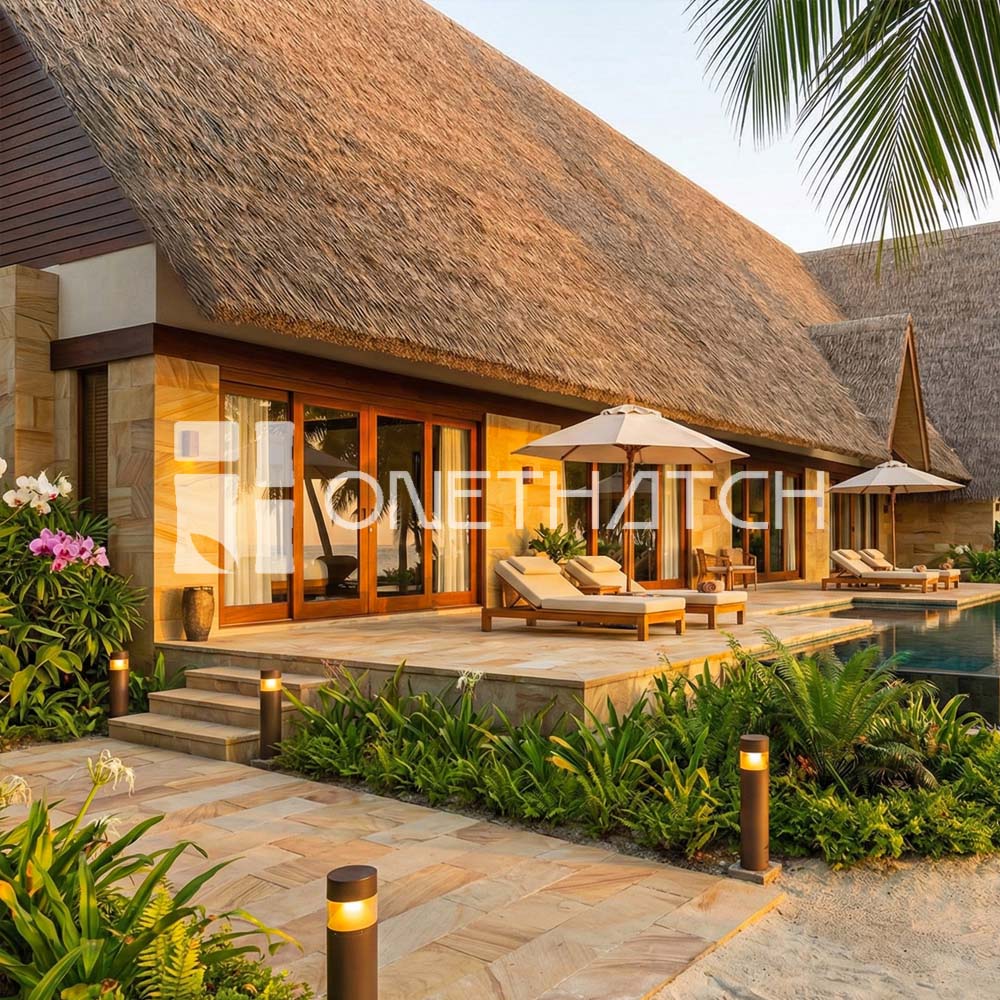
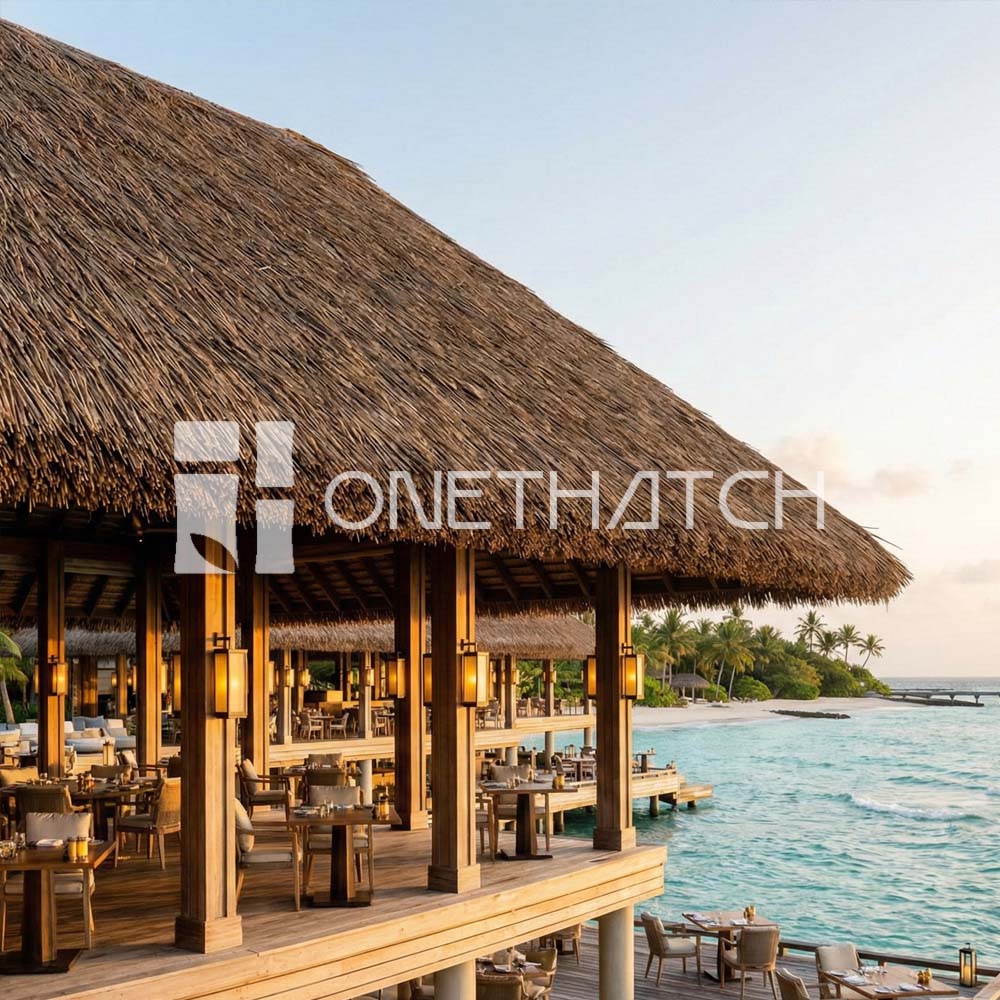
From a simple tiki hut to an African lodge-style roof, ONETHATCH REED brings the layered look of a reed thatched roof to resorts, safari lodges, theme parks and private homes.


Tested
Video
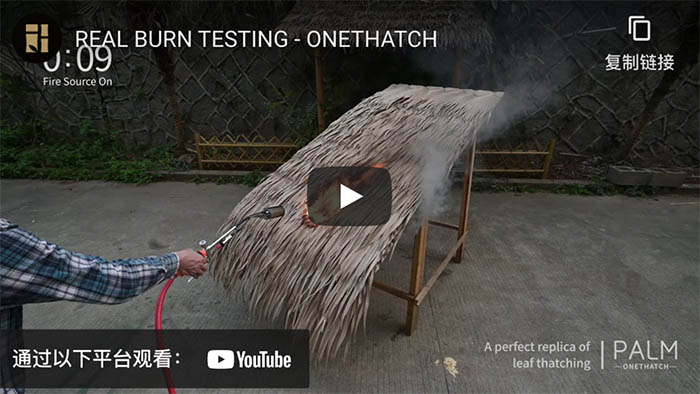
ONETHATCH REED is available in an FR (fire-retardant) version rated Class A to ASTM E108, for projects that must meet fire-rated building codes. Click the Play button below to watch a real burn test of our FR synthetic thatch.
Tested & Certified
Warranty
ONETHATCH REED is backed by a 20-year limited warranty covering rot, delamination, UV degradation and, in the first 10 years, base-color fading.
01. Fire Retardant
Test: ASTM E 108 “A”
Tested by: Intertek
Result: The FR version of ONETHATCH REED is rated Class A to ASTM E108 (Intertek report 220927005SHF-001).
02. Weather Resistant
Test: ASTM G155 (5,000 h)
Tested by: Micom Laboratories (Canada)
Result: ONETHATCH thatching reed is chemical and UV resistant, with excellent color-fastness.
03. Screw-Fixed
Fixing: Stainless roofing screws, 4 per panel
Result: Every ONETHATCH REED panel is screw-fixed over a solid sub-deck, so there are no loose bundles for the wind to lift.
04. Mold Resistant
Test: ASTM G 21-96
Tested by: Intertek
Result: ONETHATCH water reed shingle resists mold growth, and its HDPE contains no plant material for rot or insects to feed on.
Download
Product Information
Download the data sheet, brochure and installation guide below. If you need further information for your synthetic reed thatch project, our team is here to help.
Reed Thatch Resources
Specifications, uses, the roof system, buying and answers, all in one place.
A Reed Roof Without the Re-Thatching
ONETHATCH REED gives safari lodges, lapas and resort villas the full, neatly trimmed reed roof guests expect, in UV-stabilised HDPE that does not rot, shed or need re-thatching. Its FR version is rated Class A to ASTM E108 by Intertek, and every panel carries a 20-year limited warranty.
Every REED roof is built from one matched system of eave, starter, field, and hip and ridge panels in Sundried or Aged, fixed with stainless roofing screws over a solid sub-deck, so the eaves, hips and ridge look as full as the rest of the roof. Send us your roof drawing and we will work out the quantities and send free samples, direct from our own ISO 9001 certified factory.
ONETHATCH REED Specifications at a Glance
| Look | African Cape reed and European water reed thatching, in Sundried and Aged finishes |
|---|---|
| Material | UV-stabilised HDPE reed strands; PVC-free and 100% recyclable |
| Field panel | 1000 × 500 mm |
| Coverage | About 5 panels per m²; send your roof drawing for an exact quantity |
| Roof system | Eave, starter, field, and hip and ridge thatch panels |
| Fixing | 4 stainless roofing screws per panel, over a solid sub-deck |
| Fire | FR version: Class A to ASTM E108 (Intertek report 220927005SHF-001). The NFR version carries no fire rating. |
| UV weathering | 5,000 h ASTM G155, no significant colour change (Micom Laboratories, report MI-25-17428-1) |
| Warranty | 20-year limited warranty on FR and NFR versions |
| Lead time | 30 days for a 40 ft container |
A Complete Reed Roof System
ONETHATCH REED is a full roof system, not a single panel: eave, starter, field, and hip and ridge panels finish every part of the roof. Each 1000 × 500 mm field panel is fixed with four stainless roofing screws over a solid sub-deck, at about 5 panels per m². REED works on a roof pitch from 18° (about 4:12), where natural reed usually needs a much steeper roof, so it suits low-pitched lodges and pavilions too.
Natural Reed, Synthetic Reed or a Hard Roof?
Three ways to roof a lodge, side by side.
| Natural reed (Cape reed, water reed, sapê grass) | ONETHATCH REED | Hard roof (tile, slate, metal) | |
|---|---|---|---|
| Look | Authentic, softens as it ages | Neatly trimmed Cape reed and water reed look, in Sundried or Aged | No thatch character |
| Build-up | Thick stem layer tied or stitched to battens; needs a steep pitch | Screw-fixed panels over a solid sub-deck, from 18° | Tiles or sheets on battens or deck |
| Upkeep | Combing, ridge repairs, pest and fire-retardant treatments; re-thatching every few years in humid or coastal climates | An occasional rinse; no re-thatching | Low |
| Fire | Burns readily unless treated, and treatments wear off | FR version: Class A to ASTM E108; NFR: no rating | Usually non-combustible |
| Warranty | None from nature | 20-year limited warranty | Varies by product |
| Material | Plant stems | UV-stabilized HDPE, PVC-free and 100% recyclable | Clay, concrete, stone or steel |
A hard roof wins on simplicity in planning: it rarely needs extra fire distances and lasts with little care. What it cannot give you is the silhouette that makes a lodge feel like a lodge. ONETHATCH REED sits between the two: the look guests travel for, with care measured in rinses, not re-thatches.
Comfort Under a Reed Roof: Insulation and Storms
The look of depth, with comfort built in below.
Natural reed is famous for keeping houses warm in winter and cool in summer. That comes from its sheer depth: a natural reed roof is a thick layer of dry stems. ONETHATCH REED gives you the look of that depth in a far slimmer roof, and comfort comes from the build-up below it: the solid sub-deck and the insulation your architect specifies. Want a high insulation value? Design it into the deck, and the reed simply finishes the roof.
Storms are handled the same way. Every REED panel is screwed down with four stainless roofing screws into the solid deck, so there are no loose bundles for the wind to lift. For exposed sites, your engineer designs the frame and deck for local wind loads.
Fire Distances, Hard Roofs and Permits
A reed roof is a planning decision as well as a design one.
In many countries, natural thatch is treated as a “soft” roof: building rules can require extra distance to the boundary, to neighboring houses and to carports, and some plots simply cannot take one. Synthetic reed changes part of that conversation. The FR version of ONETHATCH REED is rated Class A to ASTM E108 (Intertek report 220927005SHF-001), the US fire test for roof coverings. The standard NFR version carries no fire rating.
- It supports your application. Architects and insurers can see a named standard, a class and a report number.
- It does not replace local approval. Whether a reed-look roof counts as a hard roof, what distance it needs from other buildings and whether it suits a particular plot is decided by your local building authority under its own rules.
- Combined roofs need a plan. Where a reed roof meets a tiled or metal roof, or sits beside a garage or carport, ask your architect to check the distances and junction details before you order.
Fireplaces and chimneys. A fireplace under a thatched roof is one of life’s great pleasures, and it needs care. Whether a chimney or wood stove is allowed under a reed roof is set by local fire rules, not by the roof covering alone. Specify the FR version, keep the flue and its clearances exactly as the local code and the stove maker require, and fit a spark arrestor.
Cape Reed and Water Reed, Without the Upkeep
Our synthetic water reed thatch recreates the clean, dense lines of a European water reed roof, while the same panels give safari lodges and lapas the neatly trimmed profile of African Cape reed. Choose the warm Sundried finish or the brown-grey Aged finish.
Where it works best. Safari lodges and game lodges, lapas and braai areas, resort villas and spa pavilions, theme park and zoo buildings, and private homes that want a hand-thatched look without the maintenance of natural reed.
The African Reed Ceiling, Inside and Out
Cape reed on the outside, a warm ceiling on the inside.
Look up inside a classic safari lodge and you see reed: the warm, ribbed underside of the thatch. An African reed ceiling is half the charm of a lapa. Because ONETHATCH REED fixes over a solid sub-deck, the deck itself becomes the ceiling, and you choose how it looks. Line it with our synthetic bamboo matting, hand-woven in 13 mm strands, or fill it with synthetic bamboo poles in a 25 + 35 mm mix for the close-laid look of a traditional reed and pole ceiling. Both carry the same 20-year limited warranty, and both suit covered spaces where natural reed would gather dust, insects and mold.
Reed Roofs, Not Reed Fences
Built as a roof, from eave to ridge.
REED is engineered as a roof: matched eave, starter, field, and hip and ridge panels, screwed down course by course. For a screen or boundary with the same natural warmth, our synthetic bamboo fencing is built for the job, in eight Japanese styles on powder-coated aluminum frames. Rolled plastic reed fencing tends to sag, show its wire backing and fade in strong sun; a framed bamboo fence stays straight and carries a 20-year limited warranty.
For Commercial Buyers
Buy direct from the synthetic reed thatch manufacturer. We supply synthetic reed thatch wholesale to distributors, contractors, lodge builders and resort projects, and as a synthetic reed thatch supplier shipping to more than 80 countries we send free samples and a quantity take-off from your roof drawings. For lodges, restaurants and hotels, specify the FR version, rated Class A to ASTM E108.
What Shapes the Cost of a Synthetic Reed Roof
Every reed roof is priced to its drawing.
That is the honest answer, and the useful one. We do not publish a synthetic reed thatch price per square meter, because two roofs with the same area can need very different kits. What moves the number:
- Roof shape. A simple gable needs mostly field panels. Hips, valleys, cones, dormers and curved eaves call for more hip and ridge pieces, more cutting and more time on site.
- FR or standard. The FR version, rated Class A to ASTM E108, has its fire retardant built into the material. Specify it for lodges, restaurants and hotels.
- Finish and quantity. Sundried or Aged, a single lapa or a container load for a whole lodge.
- The roof underneath. REED fixes with four stainless screws per panel over a solid sub-deck, so the deck, insulation and framing belong in your budget too.
- Destination. Freight, duties and local handling depend on where the roof is going.
Complexity costs more than size. A long, simple roof is the most economical way to buy reed. Every hip, valley, dormer, cone or round eave adds finishing pieces, cut panels and installer time. If budget matters, share the drawing early: a small change to a dormer or valley can save more than any discount.
Then look at the whole life of the roof. A natural reed roof keeps costing: combing, ridge repairs, pest and fire-retardant treatments, and a full re-thatch every few years in humid or coastal climates. ONETHATCH REED has no re-thatching cycle and carries a 20-year limited warranty, so the roof you pay for once is the roof your guests see season after season.
Bring us your drawing, your location and the look you love. Send your roof drawing and we will check the eave, starter, field, hip and ridge quantities with your quote and send free samples in both finishes.
Data sheets and guides. Download data sheets, installation guides and limited warranties for every product line on our Technical Resources page.
Synthetic Reed Thatch FAQ
ONETHATCH REED synthetic reed thatch, also called artificial reed thatch, is made of UV-stabilised HDPE reed strands in varied lengths and colours, assembled into panels on a reinforced plastic binder strip. The material is PVC-free and 100% recyclable, and the panels come in a standard (NFR) version and an FR (fire-retardant) version.
It recreates both. Its layered strands give the neatly trimmed profile of African reed thatch on safari lodges and lapas, and the same panels suit roofs styled on European water reed thatching. Choose the warm Sundried finish or the brown-grey Aged finish, and ask for samples to compare on site.
Only the FR version is. The FR version of ONETHATCH REED is rated Class A to ASTM E108 (Intertek report 220927005SHF-001); the standard NFR version carries no fire rating. Specify FR wherever the building code or insurer requires a fire-rated roof covering.
Each panel is fixed with four stainless roofing screws over a solid sub-deck, on a roof pitch of at least 18° (about 4:12), and the system includes eave, starter, field, and hip and ridge panels for each part of the roof. Allow about 5 panels per m², and send us your roof drawing for an exact quantity. The installation guide is in the downloads above.
ONETHATCH REED carries a 20-year limited warranty on FR and NFR versions, and ONETHATCH thatch passed 5,000 hours of ASTM G155 accelerated weathering (Micom Laboratories, report MI-25-17428-1). There is no re-thatching cycle; plan only for occasional cleaning and inspection. Actual service life depends on climate, exposure and installation.
A natural Cape reed roof lasts only as long as it is maintained: it needs regular combing, ridge repairs, fire-retardant and pest treatments, and eventually a full re-thatch, and in humid or coastal climates it wears much faster. ONETHATCH REED keeps the Cape reed look without that cycle: it passed 5,000 hours of ASTM G155 accelerated weathering with no significant colour change, resists mould in ASTM G21 testing, and carries a 20-year limited warranty covering rot, delamination and UV degradation.
For fire, the FR version is. Natural reed is a dry plant material that burns readily and usually needs repeated fire-retardant treatment. The FR version of ONETHATCH REED is rated Class A to ASTM E108 (Intertek report 220927005SHF-001), with the fire retardant built into the material, so there is nothing to re-spray. For lodges, restaurants and hotels, specify FR; the standard NFR version carries no fire rating.
Yes. ONETHATCH REED is installed on roofs from 18° (about 4:12), much flatter than natural reed thatching usually allows. The panels screw down over a solid sub-deck with four stainless roofing screws each, so the roof stays neat and secure on gentle slopes. Send us your roof drawing and we will confirm the layout and quantity.
No. Every quote is worked out from your roof drawing, because the shape, finishing pieces, the FR option, quantity and destination all change the cost. Send us the drawing and we will check the quantities with your quote and send free samples, so you compare real numbers for your roof.
The reed panels finish the roof; the insulation sits underneath. Specify insulation in or under the solid sub-deck to the value your climate and building code require, and the roof performs like any well-built insulated roof, with the reed look on top.
Yes, if you are comfortable on a roof. There is no thatching craft to learn: each panel is fixed with four stainless roofing screws over a solid sub-deck, course by course, from the eave and starter panels up to the hip and ridge. For large or complex roofs, a local roofer can follow our installation guide.
Yes, a simpler one. Natural reed needs a steep pitch and a thick layer of stems tied to battens. ONETHATCH REED needs a solid sub-deck and a pitch from 18°, so roofs can be lower, lighter in appearance and easier to engineer.
ONETHATCH has made synthetic thatch since 1996 and ships to more than 80 countries. The FR version of REED is rated Class A to ASTM E108, and REED passed 5,000 hours of ASTM G155 accelerated weathering with no significant color change, backed by a 20-year limited warranty. Ask us for samples and judge for yourself.
Sooner than most owners expect in warm, humid or coastal climates. Natural reed needs ongoing repairs and, every few years in those climates, a re-thatch of worn areas or the whole roof. A synthetic reed roof has no re-thatching cycle.
A tile, slate or metal roof is usually non-combustible, easy to permit and low in upkeep. Its drawback is the look. If you want the thatched silhouette with an easier fire conversation, ask about the FR version of ONETHATCH REED and its ASTM E108 Class A rating.
No. ONETHATCH REED is made from UV-stabilized HDPE strands in varied lengths and tones, with UV stabilizers selected together with BASF engineers, so it keeps its color and stays supple in strong sun.
For the same reasons as reed: no rot, no re-thatching, an FR version rated Class A to ASTM E108 and a 20-year limited warranty. For a looser grass-thatch look, see our STRAW styles; for a trimmed reed look, choose REED.
Pricing
Get A Quote
Large projects can qualify for our factory-direct pricing.
Discount
Commercial Buyer?
Make the roof part of your design, down to its colour and profile. Tell us the style you want for your thatch roofing project so we can discuss the available options. For larger projects, ask about factory-direct pricing.
As the manufacturer and supplier of ONETHATCH synthetic reed thatch, we sell wholesale to distributors, contractors and resort projects from our own ISO 9001 certified factory in Xiamen, China. REED production takes 30 days for a 40 ft container.
 English
 Japanese
 Arabic
 Spanish
 French
 Portuguese
 Italian
 German
 Chinese (China)
 Thai
 Vietnamese
 Indonesian
 Korean
 Chinese (Taiwan)
 Russian