


The most typical spot to find thatch-roofed structures is along the beach. And what does the beach have other than thatched roof resorts? Sand, waves and sun. Lots and lots of sun!
Although every beach lover enjoys the sun, it can be quite rough on roofs. In particular, authentic natural thatch roofs do not hold up well to the continuous, direct exposure to intense UV rays that they typically get at the beach.
Without UV protection, thatch that once looked so bright and lively begins to fade. As its colour disappears, it starts to look old and worn. UV-resistant thatch is made to hold its colour: our synthetic panels passed 5,000 hours of ASTM G155 accelerated weathering at Micom Laboratories (Canada) with no significant colour change.
Plus, artificial thatch made with UV stabilisers is designed to resist the brittleness that strong sun brings to natural leaves and grass, and our 20-year limited warranty covers UV degradation. Care stays as simple as the day it was installed: an occasional rinse and inspection, with no sealing or treatments.
If you want your thatch roof to last, it has to be made for years of direct sun. UV stabilisation is what keeps artificial thatch looking fresh, season after season.
Plus, our PALM, REED and STRAW panels come in a fire-retardant (FR) version, rated Class A to ASTM E108, for roofs where fire safety matters.
Does synthetic thatch fade?
Quality synthetic thatch is built to resist fading, though no outdoor material is untouched by years of sun. In our ONETHATCH panels the colour is compounded right through the UV-stabilised HDPE rather than painted on the surface, and they passed 5,000 hours of ASTM G155 accelerated weathering with no significant colour change.
Lab hours are not calendar years, so we never convert one into the other. What the result tells you is that the pigments and stabilisers held up under a long, harsh, carefully measured dose of light, heat and water.
Why do sun-facing roof planes look paler than shaded ones?
Because they receive far more sunlight. On any pitched roof, the plane that faces the midday sun takes the strongest UV and heat, while the shaded plane gets a fraction of it; rain, dust and salt spray also settle differently on each side.
On natural thatch the difference shows quickly, as the sunny side bleaches and greys. On a UV-stabilised synthetic roof any change is gradual, and an occasional rinse removes the film of dust and salt that can make one plane look duller than another.
Sundried or Aged: which colour suits your roof?
Choose the colour for the look you want on opening day, because it is compounded into the material, not applied over it. Sundried brings the warm tone of freshly dried leaves, grass and reed. Aged recreates the softer, mellowed browns of thatch that has seen a few seasons, so the roof looks settled into its setting from the start.
Colour names vary by style: ONETHATCH PALM comes in Aged Palm and Sundried Palm, ONETHATCH STRAW in Aged Thatch and Sundried Thatch, and our reed as ONETHATCH REED (AGED), a brown-grey Aged blend, or ONETHATCH REED (SUNDRIED). Ask for samples to see each tone in your own light.
ASTM G155, ASTM G154 or an SGS UV test: what is the difference?
All three describe accelerated weathering in a laboratory, but they are not the same test and their hours cannot be compared. ASTM G155 uses a xenon-arc lamp, which simulates the full spectrum of sunlight (ultraviolet, visible light and heat), with cycles of water spray. ASTM G154 uses fluorescent UV lamps that concentrate on the ultraviolet band, with condensation cycles for moisture.
‘SGS UV test’ is not a standard on its own: SGS is a testing company, so the name tells you who ran a test, not which method was used. Always ask which standard, which lab, how many hours and what result.
| ASTM G155 | ASTM G154 | ‘SGS UV test’ | |
|---|---|---|---|
| Light source | Xenon arc, full sunlight spectrum | Fluorescent UV lamps (UVA or UVB) | Depends on the method SGS was asked to run |
| Moisture | Water spray cycles | Condensation cycles | Depends on the method |
| What it shows | Colour and surface change under full-spectrum light | Colour and surface change under concentrated UV | Whatever the named standard measures |
| Our synthetic thatch | Passed 5,000 hours, no significant colour change (Micom Laboratories, Canada) | No report held | No report held |
We hold the ASTM G155 result for our thatch; we do not hold an ASTM G154 or SGS UV report. For the full story of the test across our thatch and bamboo, see what 5,000 hours of ASTM G155 weathering shows.
Is synthetic thatch suited to beachfront roofs?
It is made for sunny, coastal settings: our synthetic thatch is UV-stabilised HDPE, fixed with stainless roofing screws, and it passed 5,000 hours of ASTM G155 accelerated weathering with no significant colour change. Rinse away salt now and then to keep the colour looking its freshest. Our thatch already tops resort roofs at Kuda Rah Resort in the Maldives and on Wavi Island in Fiji.
Does UV resistance make a thatched roof last longer?
It helps: UV stabilisers protect the material from the sun, which is one of the main reasons a synthetic roof skips the natural re-thatching cycle. For the full answer on natural and synthetic lifespans, read how long does a thatched roof last.
Contact ONETHATCH for a consultation
You no longer have to accept natural thatch and bamboo that fade, rot and need renewing every few years. Whether you are covering a single gazebo or an entire resort, we’d love to help you choose the right synthetic thatch for your project.
Check out our synthetic thatch roofing products now to discover one that’s right for you:
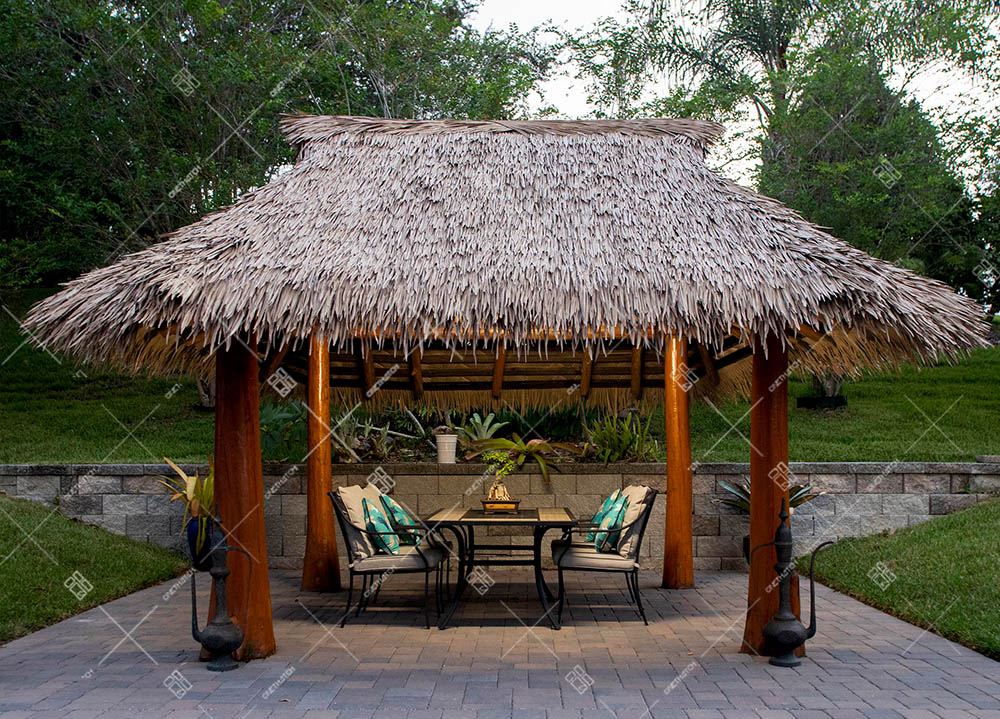
Synthetic palm thatch: ONETHATCH PALM (FAN)
ONETHATCH PALM (FAN) is moulded from casts of real palm leaves, so every panel carries the natural shape and texture of a palm-thatched roof.
Synthetic Cape reed thatch: ONETHATCH REED (AGED)
ONETHATCH REED (AGED) recreates the textured, brown-grey look of weathered African Cape reed thatch, the roof of the classic lodge and lapa. For a warmer, sun-dried tone, choose ONETHATCH REED (SUNDRIED).

Synthetic straw thatch: ONETHATCH STRAW (CARIBBEAN)
ONETHATCH STRAW (CARIBBEAN) recreates the natural brown and light tan tones of island straw thatching, typically used in tropical locations throughout the world.
Synthetic Bali thatch: ONETHATCH STRAW (BALI)
ONETHATCH STRAW (BALI) captures the charm of alang-alang grass thatch and Hawaiian pili grass, the classic roofs of Bali and the South Pacific islands.

Synthetic Tahitian thatch: ONETHATCH STRAW (TAHITIAN)
ONETHATCH STRAW (TAHITIAN) recreates the appeal of natural Tahitian palm thatching, also known as Fiji thatching, typically used across the Tahitian islands and the South Pacific.
Every style above is UV-stabilised, fixed with stainless roofing screws and backed by our 20-year limited warranty. Request samples and a quote to see the colours in your own sunlight.
 7 reasons to choose synthetic palm thatch
 Kenninji-Gaki, the classic Japanese bamboo fence
 How to install ONETHATCH PALM (NIPA), step by step
 English
 Japanese
 Arabic
 Spanish
 French
 Portuguese
 Italian
 German
 Chinese (China)
 Thai
 Vietnamese
 Indonesian
 Korean
 Chinese (Taiwan)
 Russian