


1. Resort Villas & Bungalows: Elevate the Guest Experience
In the competitive world of luxury travel, aesthetics reign supreme. Synthetic thatch provides the coveted tropical look that draws guests in and creates unforgettable moments. Crafted from UV-stabilised HDPE that cannot rot and gives pests nothing to feed on, it needs no re-thatching and no sealing, so your team spends its time on guests rather than on roof works. Imagine stunning African thatched villas and bungalows blending seamlessly with the landscape, offering a picture-perfect getaway year-round.

2. Restaurants & Beach Bars: Durable Style by the Shore

3. Theme Parks & Zoos: Creating Immersive and Lasting Environments

4. Residential Tiki Huts & Gazebos: Your Private Backyard Paradise
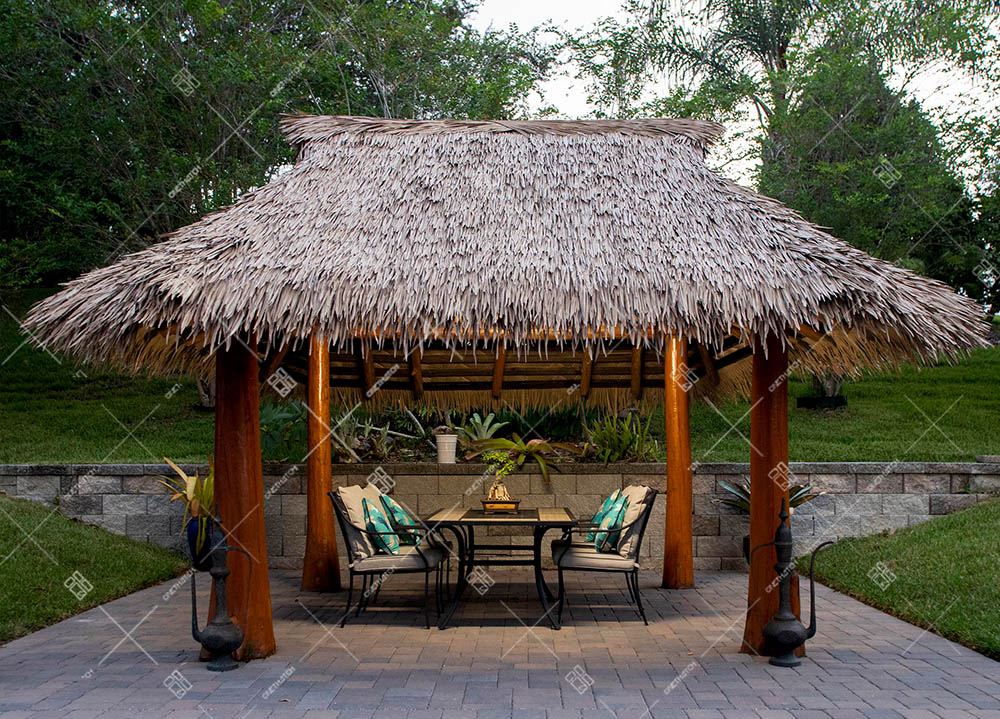
Which Synthetic Thatch Suits Caribbean Sun, Salt Air and Hurricanes?
For coastal Mexico, Central America and the Caribbean, our PALM family is the natural first choice. It installs on open battens and sheds rain without a solid sub-deck or membrane when installed to specification, and its NIPA style carries the wind results resort engineers ask for.
ONETHATCH PALM (NIPA) passed ASTM D3161 at 160 mph (260 km/h) with no loss of attachment, as well as Florida TAS 100. These are laboratory results, not a site design wind speed, so your engineer still sets the structure and fixing plan for your location. Every panel is fixed with stainless roofing screws, a detail that matters by the sea.
Then choose the look: RAINCAPE for the woven rain-cape texture of Mexican and Caribbean palapa roofs, FAN for the fuller, rugged fan-palm look, and NIPA for a neat, close-layered island roof. All three are moulded from real palm leaves in UV-stabilised, PVC-free HDPE. Explore the full synthetic palm thatch range, or, for a softer straw silhouette, our Caribbean straw thatch panels, which install over a solid, waterproofed sub-deck.
Natural Palm Thatch vs Synthetic Thatch at a Glance
Natural palm thatch is beautiful and local, but it asks for re-thatching every few years. Synthetic thatch keeps the look and takes away the recurring roof work.
| Question | Natural palm thatch | ONETHATCH synthetic thatch |
|---|---|---|
| Re-thatching | Every few years | None |
| Rot and pests | Leaves decay and can harbour insects | HDPE does not rot and offers pests nothing to eat |
| Fire | Dry leaf burns readily; often relies on fire-retardant treatments | FR version rated Class A to ASTM E108; standard NFR version unrated |
| Roof build-up | Open frame | PALM (NIPA): open battens at 220 mm; REED and STRAW: solid sub-deck at 200 mm |
| Care | Treatments, repairs and replacement | An occasional rinse and inspection |
Fire Rules for Palapas, Beach Bars and Restaurants
Fire and building rules are set locally, by country, island or municipality, so confirm the requirement with your local authority before you specify a roof.
Where a rating is required, specify our FR (fire-retardant) version: the FR PALM, REED and STRAW panels are rated Class A to ASTM E108, tested by Intertek. The standard NFR panels carry no fire rating and suit projects where none is called for. Our guide to fire-rated synthetic thatch for resorts and palapas explains the FR test in plain language.
Real Projects: Synthetic Thatch and Bamboo in the Maldives
In the Maldives, where island resorts live with fierce sun, salt spray and monsoon rain, our materials are already at work. Kuda Rah Resort chose our synthetic thatch for its thatch roof, together with our woven matting, and Banyan Tree Maldives frames its spaces with our synthetic bamboo fence.
These are the same conditions Caribbean and Pacific-coast resorts face every season. Read how Maldives resorts use synthetic thatch roofing for the full story.
Completing the Palapa Look with Synthetic Bamboo
A thatched palapa feels complete when its posts, bar front and railings belong to the same island story. Our synthetic bamboo poles are moulded from real bamboo in ASA resin, with the base colour moulded all the way through, in Sundried as standard and custom colours for commercial projects.
They are decorative rather than load-bearing: for a structural post, a metal tube goes inside the pole, so you keep the warmth of bamboo with the strength your engineer specifies.
Synthetic Thatch for Tropical Projects: Quick Answers
Does synthetic thatch need a sub-deck in the tropics?
ONETHATCH PALM (NIPA) does not: installed to specification on open battens at 220 mm, about 4.9 panels per m², it sheds rain on its own. REED and STRAW styles go over a solid, waterproofed sub-deck at 200 mm, about 5 panels per m².
How long does synthetic thatch last in strong sun?
Our synthetic thatch carries a 20-year limited warranty, and our PALM (NIPA) panels passed 5,000 hours of ASTM G155 accelerated weathering with no significant colour change. Natural thatch, by contrast, is typically re-thatched every few years.
What care does a synthetic thatch roof need?
No re-thatching, no sealing and no pest or fire-retardant treatments. An occasional rinse and inspection keeps the roof looking fresh, season after season.
How do I order synthetic thatch for a tropical project?
Send us the project location, roof drawings or photos, the roof area, the look you like (palm, straw or reed) and whether you need the FR version. We will send samples and prepare a quote for your specific roof.
 7 reasons to choose synthetic palm thatch
 Kenninji-Gaki, the classic Japanese bamboo fence
 How to install ONETHATCH PALM (NIPA), step by step
 English
 Japanese
 Arabic
 Spanish
 French
 Portuguese
 Italian
 German
 Chinese (China)
 Thai
 Vietnamese
 Indonesian
 Korean
 Chinese (Taiwan)
 Russian