

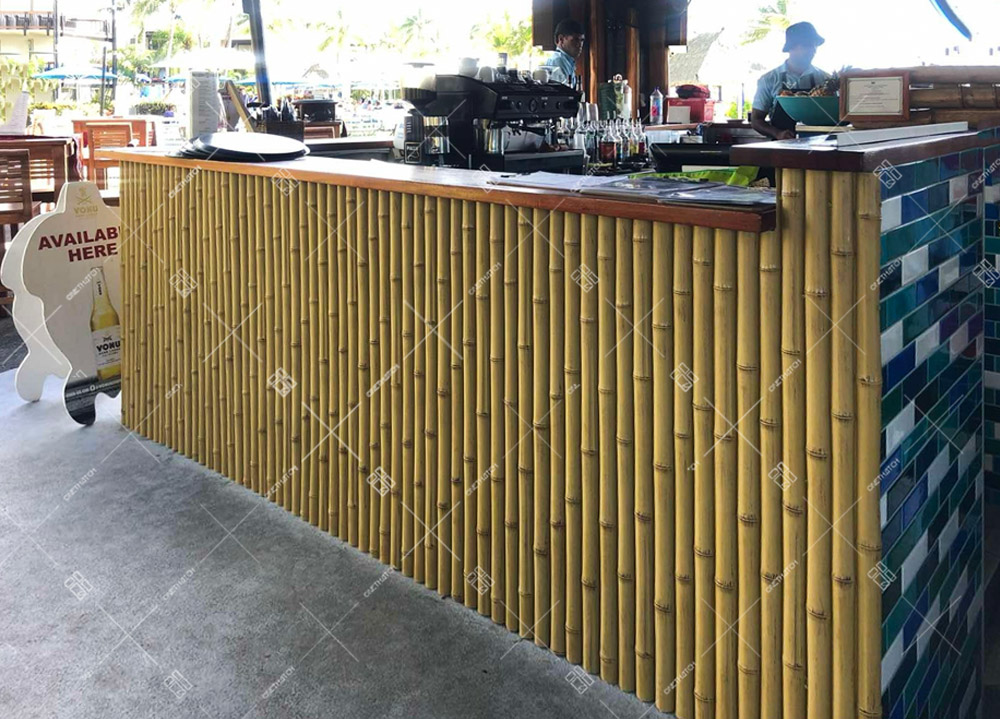
Bamboo wall cladding gives a bar, lobby, restaurant, bathroom or patio a warm, tropical or Zen character in a single surface. Natural bamboo indoors needs sealing, and outdoors it greys, splits and grows mould. Synthetic bamboo wall cladding keeps the look without that upkeep: ONETHATCH artificial bamboo panels and poles are moulded from real bamboo in weatherable ASA resin, need no sealer or varnish, and carry a 20-year limited warranty.
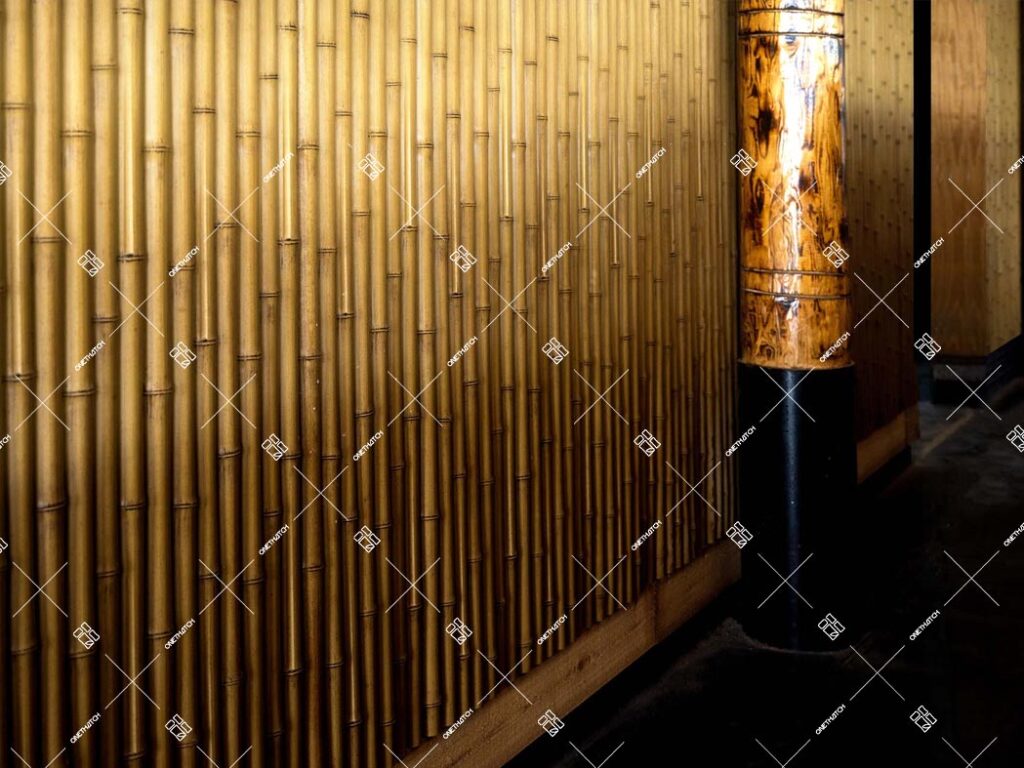
Synthetic Bamboo Wall Cladding from ONETHATCH
- Bamboo slat panels: rows of synthetic bamboo on a backing panel, in natural and black tones. They are the quickest way to clad a feature wall, a bar front or a courtyard wall, and create a tropical or Zen dining space.
- Split bamboo poles (half-round bamboo): flat on the back, so they sit tight against a wall. Use them for wall panels, bar fronts and trims.
- Full-round bamboo poles: artificial bamboo poles from slim artificial bamboo sticks up to large-diameter bamboo poles, for columns, trims and bold feature walls.
- Woven bamboo mat: HDPE woven mat for a bamboo ceiling or a bamboo wall covering, fixed to 4 mm plywood first.
Where to Use Synthetic Bamboo Wall Cladding
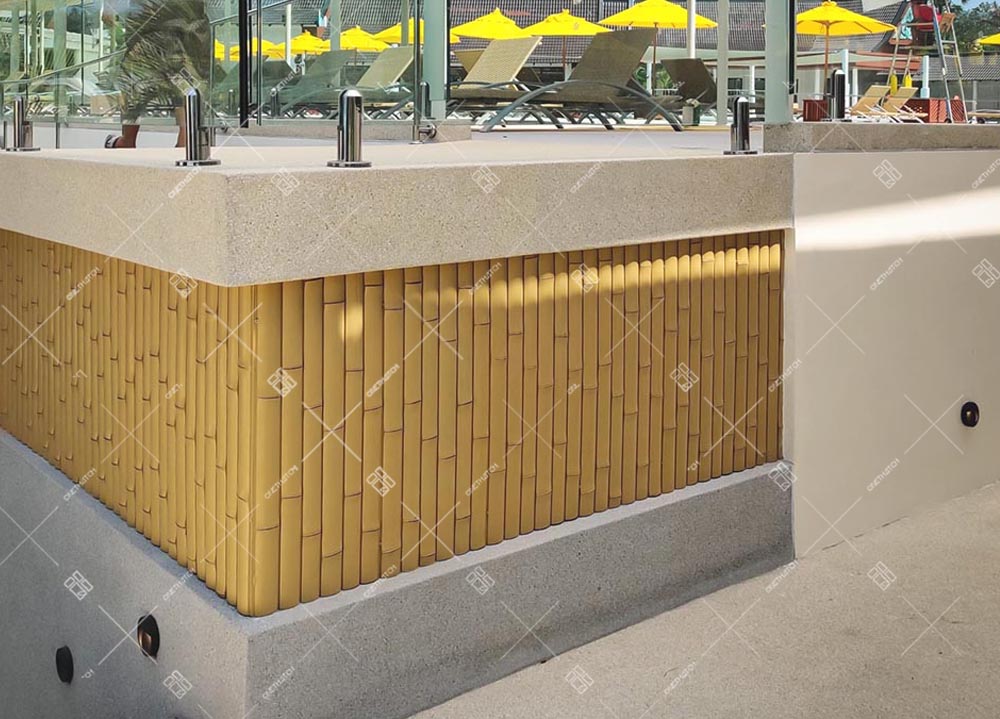
- Bars and restaurants: bar fronts, back walls and ceilings in tiki bars, beach clubs and Asian restaurants.
- Hotel lobbies and spas: feature walls that set a tropical or Zen mood from the entrance.
- Bathrooms and wet areas: synthetic bamboo is not affected by humidity, so it suits bathroom walls and pool changing rooms, where natural bamboo would mould.
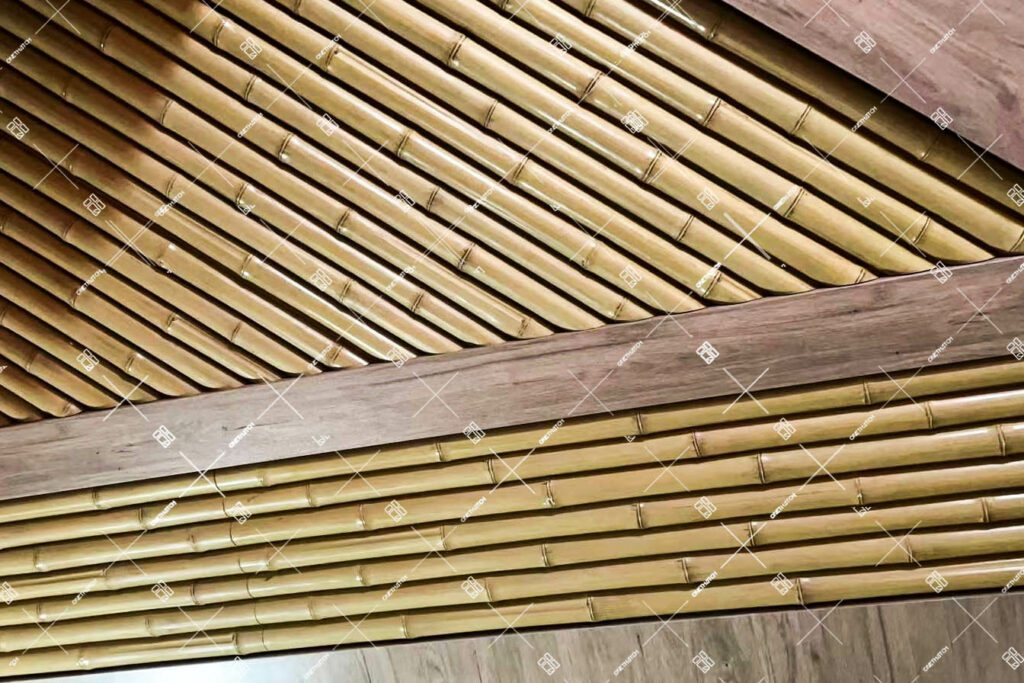
- Ceilings: HDPE woven bamboo mat, fixed to 4 mm plywood first, with bamboo poles as trims; slat panels also work on pergola ceilings.
- Patios and courtyards: refresh plain outdoor walls with bamboo slat panels or half-round poles.
- Homes and offices: balcony walls, reception desks and accent walls.

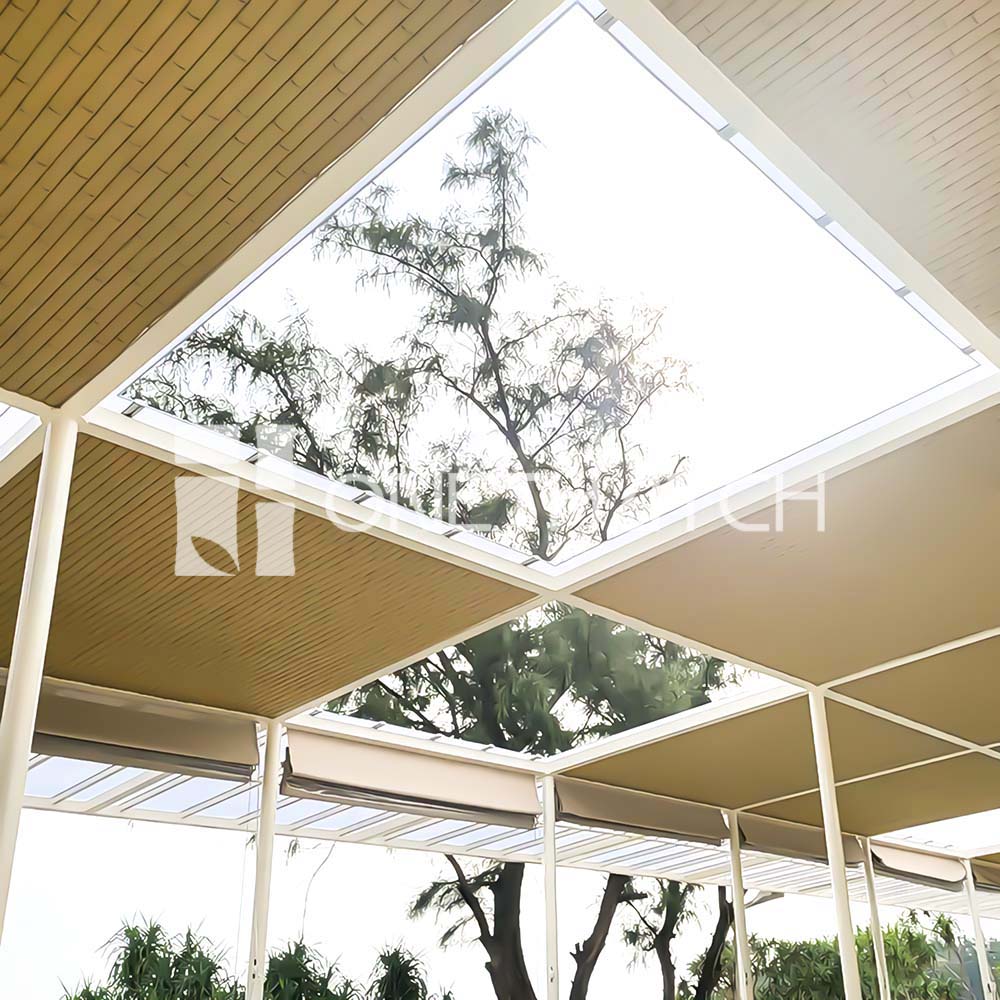
Bamboo Accent Wall Ideas for Every Room
One wall. One texture. A whole room that suddenly feels like a getaway.
These bamboo accent wall ideas use the three ONETHATCH wall finishes: the hand-woven Woven Mat (HDPE synthetic wicker in 13 mm strands), rigid bamboo slat panels (ASA resin moulded from real bamboo) and half-round poles for trims and rhythm. Mix them, and there are more ways to use bamboo wall panels than most people expect.
A bamboo accent wall bedroom guests remember
Run the Woven Mat floor-to-ceiling behind the bed and finish both edges with a slim half-round pole. The weave catches low evening light and softens the whole room, the way a resort suite does. As a tropical wall covering for bedroom walls, it brings the warmth of a beach villa without a single natural fibre to dust, mould or fade. Want more? Carry the same mat up onto the ceiling above the bed for a canopy effect.
Tropical wall coverings for home living spaces
In a living room, a slat-panel wall behind the TV or sofa gives crisp vertical lines; in a dining nook, the Woven Mat framed like a large picture panel reads as art. Teak suits light, airy interiors. Carbonized (also stocked) gives a deeper, smoky tone that pairs beautifully with black metal and stone. Both are tropical wall coverings for home use that stay the colour you chose: the material passed 5,000 hours of ASTM G155 accelerated weathering with no significant colour change.
Woven bamboo wall covering for office and reception
A woven bamboo wall covering for office receptions, meeting rooms and hotel back-of-house corridors signals calm and craft before anyone speaks. For commercial interiors, specify the fire-retardant Woven Mat, tested to ASTM E84 Class A and NFPA 286 (FR version made to order). The standard mat has no fire rating, so match the version to your local code.
A tropical wall covering for basement rooms
A basement bar, games room or home cinema gains instant character with the Woven Mat. HDPE has no plant fibre, so the mat itself gives mould and insects nothing to feed on. Fix it to a dry, sound wall and back it with moisture-resistant plywood.
Bamboo mat wall decor for bars and restaurants
Bar fronts, back-bar walls and booth backs are where bamboo mat wall decor works hardest. Frame sheets of Woven Mat with full-round poles, or wrap the bar front in slat panels and top it with a pole rail. Kuda Rah Resort in the Maldives pairs ONETHATCH PALM (NIPA) thatch with our matting; Club Med Phuket uses our bamboo poles on walls and bar fronts.
Bamboo Wainscoting: A Lower-Wall Lining with Island Character
Wainscoting protects the part of the wall that takes the knocks, and frames the room while it does.
Traditionally, timber boards or woven lauhala served as wainscoting or lining for walls in island homes. Today, bamboo wainscoting wall panels made from ONETHATCH Woven Mat or slat panels give the same relaxed look on the lower third of a wall, typically 90 to 120 cm high, capped with a half-round pole as the chair rail.
What is the best material for wainscoting?
The best material for wainscoting is one that survives scuffs, cleaning and humidity without losing its look. Solid timber and MDF need painting and repainting; natural cane and grass weaves mark and fade. A synthetic option such as ONETHATCH Woven Mat or ASA slat panels keeps its colour, needs no sealer or varnish, and carries a 20-year limited warranty. For a busy hallway or a restaurant, that is the honest best fit; for a dry formal room, painted timber still has its place.
Bamboo wainscoting wall panel options
- Woven wainscot: a strip of Woven Mat glued to plywood, framed top and bottom with half-round poles. Soft, tactile, tropical.
- Slat wainscot: bamboo slat panels in Sundried, Carbonized, Dark Chocolate or Ebony for a crisper rhythm.
- Pole wainscot: half-round poles laid vertically side by side, for a classic tiki-bar base.
How to install bamboo wainscoting
- Mark the height. Snap a level line at your chosen wainscot height, all the way round the room.
- Prepare the board. Cut plywood to the wainscot height. Glue the Woven Mat to it and secure the edges with staples (staples only, never nails).
- Fix the board. Screw the faced board to the wall or to battens. Slat panels go on solid backing or on battens at 45 cm centres with stainless screws, leaving an expansion gap at top and bottom.
- Cap and trim. Run a half-round pole along the top as the chair rail, and a pole or skirting board at the floor to hide the edge.
Our step-by-step matting guide goes deeper: How to Install Synthetic Bamboo Matting.
Woven Mat, Rigid Panels or Tambour? Choosing Your Bamboo Wall Finish
Three looks, three materials. Choose by the feeling you want and the room you are dressing.
| ONETHATCH Woven Mat | ONETHATCH bamboo slat panels | ONETHATCH half-round poles | |
|---|---|---|---|
| Material | Hand-woven HDPE synthetic wicker, 13 mm strands | ASA resin moulded from real bamboo | ASA resin moulded from real bamboo |
| Look | Soft woven texture, like hand-plaited bamboo | Bold vertical rhythm of whole canes | Classic split-cane, flat on the back |
| Format | 1.22 × 2.44 m (4 × 8 ft) sheets; 1220 mm × 50 m rolls for large projects | Panels in Sundried, Carbonized, Dark Chocolate, Tortoise, Raw Green, Raw Green Burnt, Natural Raw, Ebony | Lengths for trims, rails and full walls |
| Where | Indoor walls, ceilings, bar fronts, vertical furniture faces; covered outdoor areas | Indoor and outdoor walls, bar fronts, pergola ceilings | Trims, chair rails, bar fronts, feature walls |
| Install | Glue to plywood, staple, then fix the board | Solid backing or 45 cm battens, stainless screws | Stainless screws |
| Fire | Class A FR version (ASTM E84 + NFPA 286) to order | Class A FR option to order | ASTM E84 Class A FR version to order |
Want woven panels rather than loose sheets? Glue the Woven Mat to plywood in the workshop or on site and it becomes a ready woven panel that screws to the wall like any board; ideal for resort villa headboard walls and lobby feature walls. For larger projects we can also develop other weaves to match a design.
Pairing tip: two-tone looks are easy. Set Carbonized Woven Mat inside Teak frames, or alternate Sundried and Dark Chocolate slat panels.
Bamboo wall materials glossary: what else is out there
Many searches for bamboo wall panels indoor lead to products made of natural bamboo, wood composites or printed paper. Here is how they compare, and where ONETHATCH fits.
| Material | What it is | Where it falls short on a feature wall | ONETHATCH alternative |
|---|---|---|---|
| Bamboo plywood | Laminated sheets of pressed natural bamboo strips | Needs sealing; edges and faces mark and fade in sun | Slat panels, no finishing needed |
| Engineered bamboo / bamboo boards | Laminated or strand-woven natural bamboo boards | Flat, timber-like look; moves with humidity | Slat panels or poles for a true cane profile |
| Bamboo flooring and bamboo decking | Strand-woven boards made for floors and decks | Built for walking on, not for a woven or cane look; decking needs regular oiling outdoors | Wall finishes only (our matting is not for floors) |
| Bamboo veneer, incl. bamboo veneer 1′ x 8′ panels | Thin natural bamboo sheets on a paper or fleece backing | Shows every dent; needs a lacquer finish | Woven Mat or slat panels |
| Woven bamboo plywood / woven bamboo veneer board | Natural woven bamboo strips laminated to a board | Fibres darken, fray and can mould in damp rooms | Woven Mat: the woven look in HDPE |
| Two-tone woven bamboo wall panels | Natural strips woven in two shades | Colour drifts as the natural strips age | Teak and Carbonized Woven Mat combined |
| 3D bamboo wall panels | Carved or moulded relief tiles in bamboo fibre | Dust collects in the relief; mostly indoor-only | Slat panels for depth with clean lines |
| Bamboo tambour paneling (tambour paneling, tambour wall paneling) | Thin fluted strips on a flexible backing | Narrow flutes, a joinery look rather than cane; natural strips need finishing | Slat panels or half-round poles |
| Bamboo acoustic panels | Slatted bamboo face on an acoustic felt | Built for sound control; the bamboo face still needs sealing | Woven Mat and panels are decorative finishes |
| Guadua bamboo slats | Split slats of large South American bamboo | Need insect and fungus treatment | Slat panels moulded from real bamboo |
| Bamboo pole wrap and natural bamboo rolls | Split or whole canes wired onto fabric or wire | Canes split, fade and need sealing outdoors | Half-round poles or slat panels |
| Bamboo facade cladding | Natural or engineered bamboo used on exterior walls | Greys and checks without regular treatment | Slat panels, engineered for sun and salt air |
| Reed or cane sheets and natural bamboo mats glued to walls | Natural reed stems or bamboo mat sheets stuck straight onto plaster | Absorb moisture, darken and can mould; edges fray | Woven Mat on plywood, edges trimmed with half-round poles |
| WPC wall cladding | Wood-plastic composite boards, often fluted | A wood-grain look, not bamboo; heavy profiles | Slat panels for an authentic cane profile |
Love a look we don’t make? Send a photo of it, and we will suggest the closest ONETHATCH finish.
Natural Bamboo Cladding: Rolls, Split Screens, Guadua and Tonkin Cane
Many people searching for bamboo wall cladding start with natural bamboo. These are the most common options, and what to expect from each:
- Bamboo rolls: whole natural canes wired together into a flexible roll. They are inexpensive and quick to fix to a wall or bar front, but outdoors the canes fade, split and need regular sealing.
- Split bamboo screens: halved canes joined into a lighter, more open screen. The look is airy, but split cane is thinner and weathers faster than whole cane.
- Guadua bamboo: a large-diameter South American bamboo used for bold feature walls and structures. It is heavy and needs treatment against insects and fungi.
- Tonkin cane: a slim, straight, pale natural cane, popular for fine wall cladding and garden screens. Indoors it looks elegant; in humid or wet areas it can mould.
ONETHATCH does not sell natural bamboo. If you like one of these looks but need it to last outdoors, in a wet area or in a busy commercial space, our faux bamboo slat panels give the rhythm of a bamboo roll or screen, and our round poles come in several diameters for a slim-cane or large-pole look. Send us a photo of the look you want and we will suggest the closest match.
Natural vs Faux Grasscloth Wallpaper, and a Third Way
Grasscloth wallpaper is beautiful. It is also delicate.
Natural grasscloth wallpaper is woven grass, sisal or jute laminated onto a paper backing. It sits in the same natural fiber wall covering family as rushcloth, abaca wallpaper (abaca wallcovering, made from Manila hemp fibre) and woven panels of dried water hyacinth leaves. All bring texture. All share the same weak points.
Disadvantages to grasscloth wall paper
- Seams show. Every roll is slightly different in colour, so joins are visible.
- It fades. Plant fibres bleach in sunlight, unevenly.
- It stains. Water splashes and grease leave marks that cannot be scrubbed out.
- It dislikes humidity. Kitchens, bathrooms and basements can lift seams or grow mould.
- It snags. Pets, chairs and luggage pull fibres loose.
Faux grasscloth and printed bamboo wallpaper
Faux grasscloth answers some of this with a vinyl surface printed or embossed to look woven. It wipes clean, but it is usually PVC-based, and up close it reads flat. The same goes for faux bamboo wallpaper, bamboo mat wallpaper and bamboo-weave prints: the picture of a weave, not the weave itself. Bamboo wainscoting wallpaper, sold as a printed bamboo wainscoting wallpaper panel for the lower wall, has the same limit: no real depth, no shadow lines, nothing for the hand to feel.
The third way: a real weave that stays the colour you chose
ONETHATCH Woven Mat sits between natural vs faux grasscloth. It is a genuine hand-woven texture, with real depth and shadow, made from PVC-free, 100% recyclable HDPE coloured all the way through. No seams to hide (each 1.22 × 2.44 m sheet is framed as a panel), no fibres to bleach, nothing to soak up a splash. If you were searching for a tropical wall covering wallpaper with real texture, this is the upgrade.
| Natural grasscloth | Faux grasscloth (vinyl) | ONETHATCH Woven Mat | |
|---|---|---|---|
| Real woven texture | Yes | No, printed or embossed | Yes, hand-woven |
| Colour in sunlight | Fades unevenly | Varies by print | No significant colour change after 5,000 h ASTM G155 |
| Wipe clean | No | Yes | Yes |
| Humid rooms | Not recommended | Fair | Material is unaffected by moisture |
| Material | Plant fibre on paper | Usually PVC | PVC-free, recyclable HDPE |
| Warranty | – | – | 20-year limited warranty |
DIY Bamboo Accent Wall: A Weekend Project
A DIY bamboo accent wall is well within reach of a confident home improver. You need 4–6 mm plywood, contact cement, a staple gun, a saw and stainless screws.
- Measure the wall and plan sheet layout so joins fall where a pole trim can cover them.
- Cut the plywood to your panel sizes.
- Glue the Woven Mat to the plywood and staple the edges. Staples only, never nails.
- Fix the panels to the wall with screws, or to battens.
- Frame the joins and edges with half-round poles for a crafted, resort finish.
Prefer the rhythm of whole canes? Bamboo slat panels screw straight onto solid backing or battens at 45 cm, with an expansion gap at top and bottom. For furniture-scale projects, see our guide to woven bamboo inlays for cabinet doors and headboards.
Why Choose Synthetic over Natural Bamboo for Walls
Designers value natural bamboo as a renewable material, and indoors in a dry room it can work well. Synthetic bamboo is the better fit where the wall is outdoors, in a wet area or in a busy commercial space:
- Colour that lasts: ONETHATCH synthetic bamboo passed 5,000 hours of ASTM G155 accelerated weathering at Micom Laboratories (Canada) with no significant colour change.
- No finishing: no sealer, varnish or oil, before or after installation, which makes it an eco-friendly, low-effort choice for commercial interiors.
- No mould, rot or insects: there is no plant fibre for them to feed on.
- Easy to work: cut with ordinary woodworking tools and fix with screws.
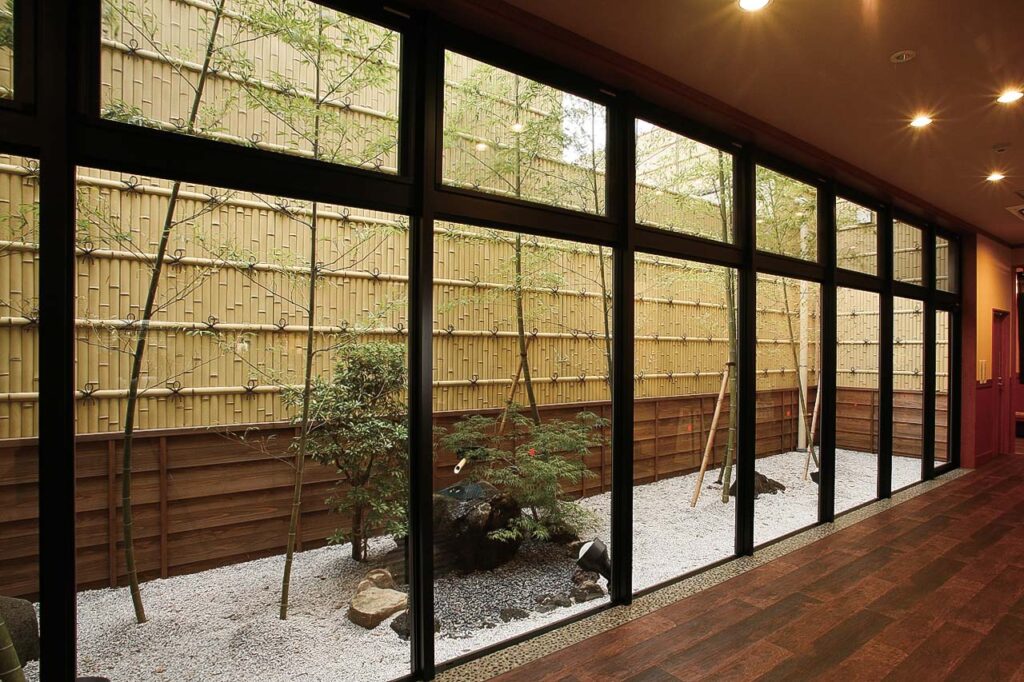
Synthetic bamboo cladding is decorative, not structural: fix it to a wall or frame designed for the load.
Bamboo Accent Wall FAQ
What are the best bamboo accent wall ideas for a small room?
For a small room, one framed Woven Mat panel behind a bed or desk adds texture without crowding the space. Keep the rest of the room plain and let the weave do the work. A half-round pole frame gives it a finished, custom look.
Can I use bamboo matting as wainscoting?
Yes. Glue ONETHATCH Woven Mat to plywood, fix the board to the lower wall and cap it with a half-round pole as the chair rail. It keeps its colour, needs no sealing and is covered by our 20-year limited warranty.
Is the Woven Mat the same as bamboo plywood or veneer?
No. The Woven Mat is hand-woven HDPE synthetic wicker, while plywood and veneer are made from natural bamboo that needs sealing. You get the woven bamboo look without plant fibre that can fade, mould or fray.
Can I use the Woven Mat or slat panels on floors or worktops?
No. The Woven Mat is designed for walls, ceilings, bar fronts and vertical furniture faces, indoors or in covered outdoor areas. It is not for floors or countertops.
How do I get the right colour for my accent wall?
Ask for free samples. Teak and Carbonized Woven Mat are in stock and slat panels come in eight colours.
Ready to plan your accent wall? Explore our bamboo wall panels and synthetic bamboo matting, then request free samples to see and feel the weave in your own light.
ONETHATCH makes all its artificial bamboo materials in its own factory, so sizes and colours can be made to order. Send your wall dimensions or drawings through our commercial enquiry form, or see our bamboo fence panels for outdoor screening.
 7 reasons to choose synthetic palm thatch
 Kenninji-Gaki, the classic Japanese bamboo fence
 How to install ONETHATCH PALM (NIPA), step by step
 English
 Japanese
 Arabic
 Spanish
 French
 Portuguese
 Italian
 German
 Chinese (China)
 Thai
 Vietnamese
 Indonesian
 Korean
 Chinese (Taiwan)
 Russian