


Some details make a room. A woven door front is one of them.
A woven bamboo cabinet door inlay turns a plain kitchen into something crafted, adds warmth to a wardrobe wall and gives a bedroom the calm of a resort suite. This guide shows how to use ONETHATCH Woven Mat, hand-woven HDPE synthetic wicker in 13 mm strands, as a door and cabinet inlay, an island front, a headboard and a room divider, and how it compares with the natural cane many people try first.
Why Synthetic Woven Mat for Furniture Faces
Doors are touched, knocked and wiped every day. Natural fibre does not love that. ONETHATCH Woven Mat was made for exactly this kind of life:
- It keeps its colour. The mat passed 5,000 hours of ASTM G155 accelerated weathering with no significant colour change, so a sunny kitchen will not bleach it.
- It stays taut. HDPE strands do not soak up water the way plant fibre does, and the mat is glued to a backing board, so there is no sagging panel after a humid summer.
- It gives mould and insects nothing to eat. There is no plant fibre in it.
- It is responsibly made. PVC-free, 100% recyclable HDPE, coloured all the way through.
- It is covered. A 20-year limited warranty, like all ONETHATCH matting.
Teak is stocked, Carbonized is also in stock, and each 1.22 × 2.44 m (4 × 8 ft) sheet yields several door inserts.
One rule first: the Woven Mat is for vertical faces only. Doors, island fronts, headboards, bar fronts, wall panels and ceilings, yes. Countertops, worktops, tabletops and floors, never.
Cane Webbing vs Synthetic Woven Mat
Cane webbing cabinet doors became a design favourite for good reason: they look light, crafted and warm. But anyone who has lived with them knows the trade-offs. Here is an honest comparison.
| Natural rattan cane webbing | ONETHATCH Woven Mat | |
|---|---|---|
| Material | Thin strips of rattan bark, woven | Hand-woven HDPE synthetic wicker, 13 mm strands |
| Typical pattern | Radio weave, an open hexagonal cane pattern | A diagonal zigzag weave of bamboo-look strips |
| Installation | Soaked in water, pressed into a groove with a spline, shrinks tight as it dries | Glued to a thin backing board and stapled, then fitted like a panel |
| Over time | Can sag, yellow and snap where hands and pets press on it | Colour stays; no fibre to fray or bleach |
| Humidity | Moves with humidity; can mould in damp rooms | HDPE strands do not soak up moisture |
| Light and air | The open weave lets light and air through | Backed by a board, so it is a solid panel |
| Warranty | – | 20-year limited warranty |
Choosing between them? If you want air to pass through a media cabinet, an open cane weave does that and the mat does not, so plan vents elsewhere. If you want a woven face that still looks fresh in years to come, in a busy kitchen or a hotel room, choose the mat.
Cane webbing kitchen cabinets: what to expect
Cane webbing kitchen cabinets live in the toughest room in the house: steam from the kettle, grease near the hob, wet hands on every door. Natural cane copes in a dry, low-traffic room; next to a sink it can stain and sag. A rattan webbing cabinet door near the cooktop also darkens over time. A synthetic woven panel avoids those problems while keeping the handmade look.
Cane webbing cabinet doors DIY vs a woven mat inlay
The classic cane webbing cabinet doors DIY project means routing a groove, soaking the cane, wedging in a spline and hoping it dries tight and square. A woven mat inlay is simpler: cut, glue, staple, fit. No soaking, no splines, no waiting.
How to Fit a Woven Bamboo Cabinet Door Inlay
The method below suits frame-and-panel (Shaker-style) doors, the easiest kind to convert.
- Remove the centre panel. Take the door off its hinges and remove the existing centre panel, or rout out the panel to leave the frame and its rebate.
- Cut a backing board. Cut thin plywood to fit the opening, the same size as the old panel.
- Face the board. Glue the Woven Mat to the plywood. Hold the edges with staples while the glue sets (staples only, never nails), then trim the mat flush with a sharp knife.
- Fit the panel. Set the faced board into the frame rebate, mat side out, and secure it from the back with small retaining strips or panel clips.
- Rehang and admire. Refit hinges and handles.
Slab doors? Frame a mat-faced board with a thin timber or half-round bamboo pole border and fix it to the face of the door as an applied panel.
Glass-front cabinets? Replace the glass with a mat-faced board for a softer, more private look.
Island Fronts and Bar Fronts
A kitchen island front is the biggest vertical surface in many kitchens, and the perfect canvas for a woven finish. Fix mat-faced plywood panels to the island carcass, frame them with half-round poles, and the island instantly becomes the centrepiece.
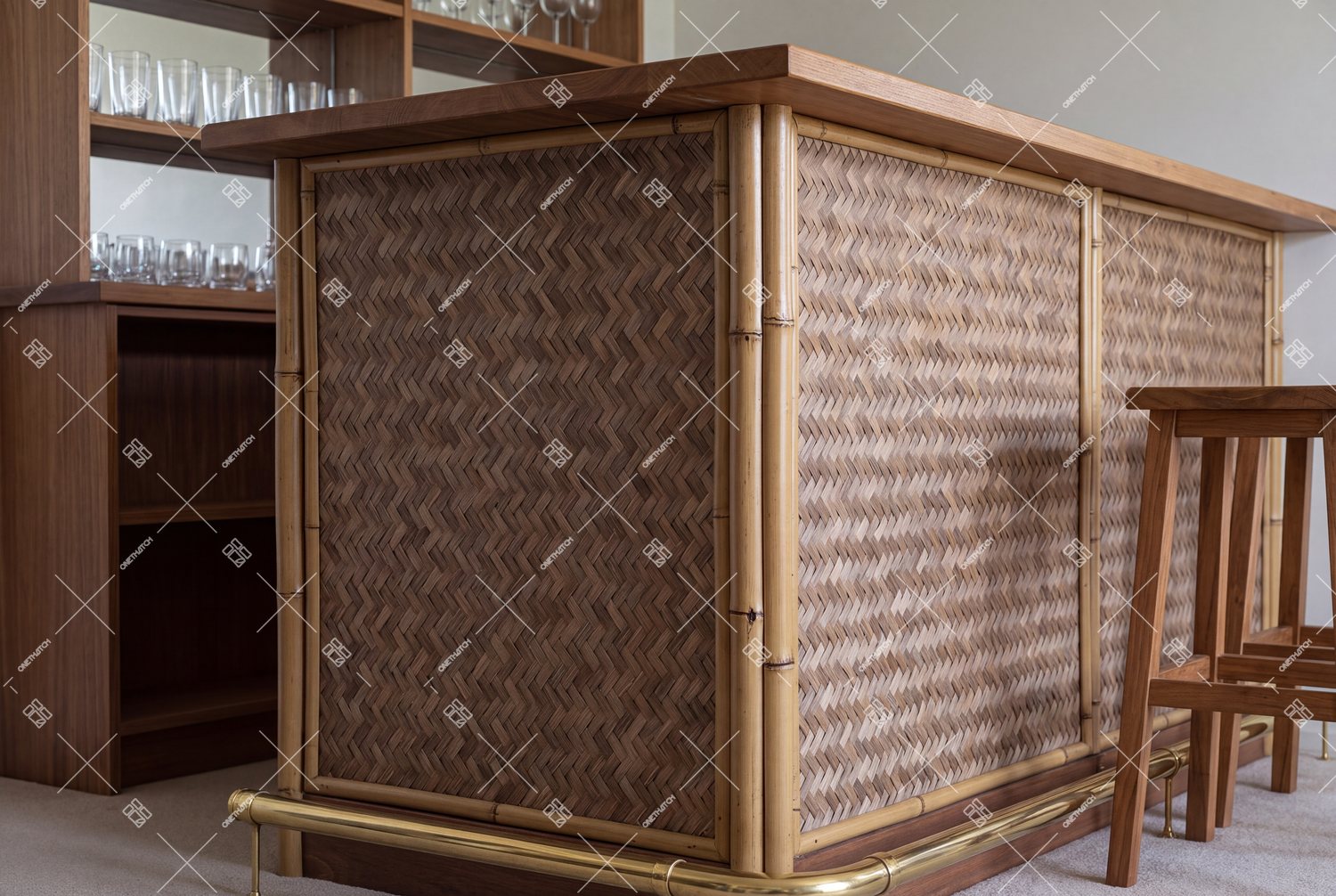
The same method dresses home bars, hotel reception desks and restaurant service counters. Under a covered terrace, it works on an outdoor-kitchen island front too, provided it stays out of direct rain. Keep the mat on the sides and front only. The top stays stone, timber or whatever your worktop is.
Bamboo Headboard Ideas
A headboard is where a bedroom tells its story. Our favourite bamboo headboard ideas:
- Framed woven panel. A wide board of Teak Woven Mat framed in half-round poles, wall-mounted behind the bed.
- Floor-to-ceiling woven wall. Run the mat from skirting to ceiling behind the bed, and carry it onto the ceiling as a canopy.
- Pole headboard. Synthetic bamboo poles set vertically, side by side, for a bold tiki-suite look.
- Two-tone. Carbonized mat in a Teak pole frame, for hotel rooms with a darker palette.
Bamboo headboard DIY in an afternoon
For a bamboo headboard DIY project, cut a plywood board to the width of your bed plus a little either side. Glue and staple the Woven Mat to it, frame the edges with half-round poles fixed with stainless screws, then mount it to the wall with a French cleat or brackets into the studs. Done before dinner.
Room Dividers that Double as Headboards
Bamboo room divider screen
A bamboo room divider screen zones a studio, a hotel suite or a restaurant floor without building a wall. Two ways to do it with ONETHATCH:
- Woven panels on a frame. Mat-faced boards (mat on both faces) set into a timber or metal frame, freestanding or fixed between floor and ceiling.
- Japanese fence panels indoors. Our synthetic bamboo fence panels, built on powder-coated aluminium frames, also make striking indoor screens; ask us how to fix one as a room divider. See all eight styles in our bamboo fencing range.
Bamboo room divider headboard
In a studio apartment or an open-plan hotel suite, a bamboo room divider headboard does two jobs: the bed backs onto it, and it screens the sleeping area from the living space. Build it as a freestanding woven panel at headboard height or taller, anchored to the floor for stability, and finish the top with a full-round pole.
Care and Cleaning
Most of the time, a dust with a soft brush or a vacuum brush attachment is all a woven panel needs. For marks, wipe with a damp cloth and a little mild soap, then let it dry. No oiling, no sealing, no re-varnishing.
FAQ
Can woven bamboo matting be used on cabinet doors?
Yes. Glue ONETHATCH Woven Mat to a thin plywood board and fit it into the door frame like a panel. It suits kitchen, wardrobe and bedroom cabinet doors indoors, and keeps its colour.
Can I put the Woven Mat on a countertop or tabletop?
No. The Woven Mat is made for vertical faces such as doors, island fronts, headboards, walls and ceilings. It is not for countertops, tabletops or floors.
Is synthetic woven mat the same as cane webbing?
No. Cane webbing is natural rattan woven in an open pattern; ONETHATCH Woven Mat is hand-woven HDPE fitted on a backing board. It gives a woven look that does not sag, yellow or snap.
Where can I see the mat up close?
Order free samples. Seeing and touching the weave next to your cabinet colour is the best way to choose between Teak and Carbonized.
Make Your Furniture the Feature
A woven door, a woven island, a woven headboard: small surfaces, big character. Explore our synthetic bamboo matting, get more wall ideas in Bamboo Wall Cladding: Applications and Design Ideas, and request free samples for your next project.
 7 reasons to choose synthetic palm thatch
 Kenninji-Gaki, the classic Japanese bamboo fence
 How to install ONETHATCH PALM (NIPA), step by step
 English
 Japanese
 Arabic
 Spanish
 French
 Portuguese
 Italian
 German
 Chinese (China)
 Thai
 Vietnamese
 Indonesian
 Korean
 Chinese (Taiwan)
 Russian