


Look up in a bahay kubo and you see the Philippines in one glance: the ribs of the roof, the shade of the nipa, and a woven ceiling that softens the light. That is the charm of amakan ceiling design, and it is why architects, resort owners and homeowners keep asking how to bring it into a modern house without the upkeep. This guide explains what amakan and sawali are, how they are used on ceilings and walls, which ceiling types suit Philippine homes, and where a synthetic woven sheet earns its place.
What are amakan and sawali?
Two weaves, one tradition. Both are woven split-bamboo mats, hand-made from thin strips of bamboo and used for centuries as walls, partitions and ceilings.
- Amakan is the broader, sturdier weave. Wide, flattened bamboo strips are interlaced into large panels, often framed in timber and nailed between posts. An amakan ceiling has a bold, rustic rhythm that reads beautifully from a distance.
- Sawali (in older spelling, sawale) is the finer cousin. Archival dictionaries describe it as a coarse twilled matting of flattened bamboo strips, woven in a tight herringbone or zigzag. The old saying “gawa sa sawali ang dingding” (the wall is made of sawali) shows how common it was as a dingding, a house wall.
Across the islands, the same panels go by many names. In the Visayas you will hear surilap and salirap; among Tausug, Yakan and Sama communities, selirap and sayrap. Sulirap is used differently from place to place: some regions mean a woven coconut-frond panel, others use it for amakan. In neighbouring Malaysia and Brunei, builders know woven palm panels as kelarai and woven bamboo as anyaman buluh, fixed to the siling (ceiling) and dinding (wall). And sala-sala is something else again: a loose, open bamboo latticework, used as a screen rather than a solid ceiling.
Native weaves at a glance
| Name | What it is | Typical use |
|---|---|---|
| Amakan | Broad woven split bamboo panel | Walls, ceilings, partitions |
| Sawali / sawale | Fine twilled weave of flattened bamboo | Walls, ceilings, furniture |
| Surilap, salirap | Visayan names for amakan | Walls, ceilings |
| Selirap, sayrap | Tausug, Yakan and Sama names for amakan | Walls, ceilings |
| Sulirap | Coconut-frond panel or amakan, by region | Walls |
| Kelarai | Woven bertam palm panel (Malay) | Walls, ceilings |
| Anyaman buluh | Woven bamboo (Malay) | Siling and dinding |
| Sala-sala | Open bamboo lattice | Screens, vents, fences |
Why native woven ceilings feel so right
A woven ceiling breathes. It diffuses light, hides the roof structure and adds texture that flat board never will. That is why the nipa hut ceiling is still the reference point for tropical design, from the classic bahay kubo to a beach resort’s open-air restaurant.
The drawbacks are just as familiar to anyone who has lived under one. Natural bamboo absorbs moisture, so it darkens and grows mould in the rainy season. Bukbok beetles and termites tunnel into it. Typhoon humidity loosens the weave, the colour turns grey within a few seasons, and the whole ceiling needs replacing sooner than the owner would like. Natural bamboo also burns easily, which matters in a restaurant kitchen or a resort lobby.
Amakan ceiling design ideas for homes and resorts
Here are amakan ceiling ideas that work in Philippine homes and hospitality spaces today.
Native amakan ceiling design for the bahay kubo
For a native amakan ceiling design, keep the structure honest: expose the rafters, fill each bay with woven panels, and frame the edges with round bamboo. In a bahay kubo or garden kubo, this is the look guests photograph. Pair it with a nipa or synthetic thatch roof for a complete nipa hut ceiling design (see why resorts choose synthetic palm thatch instead of natural palm).
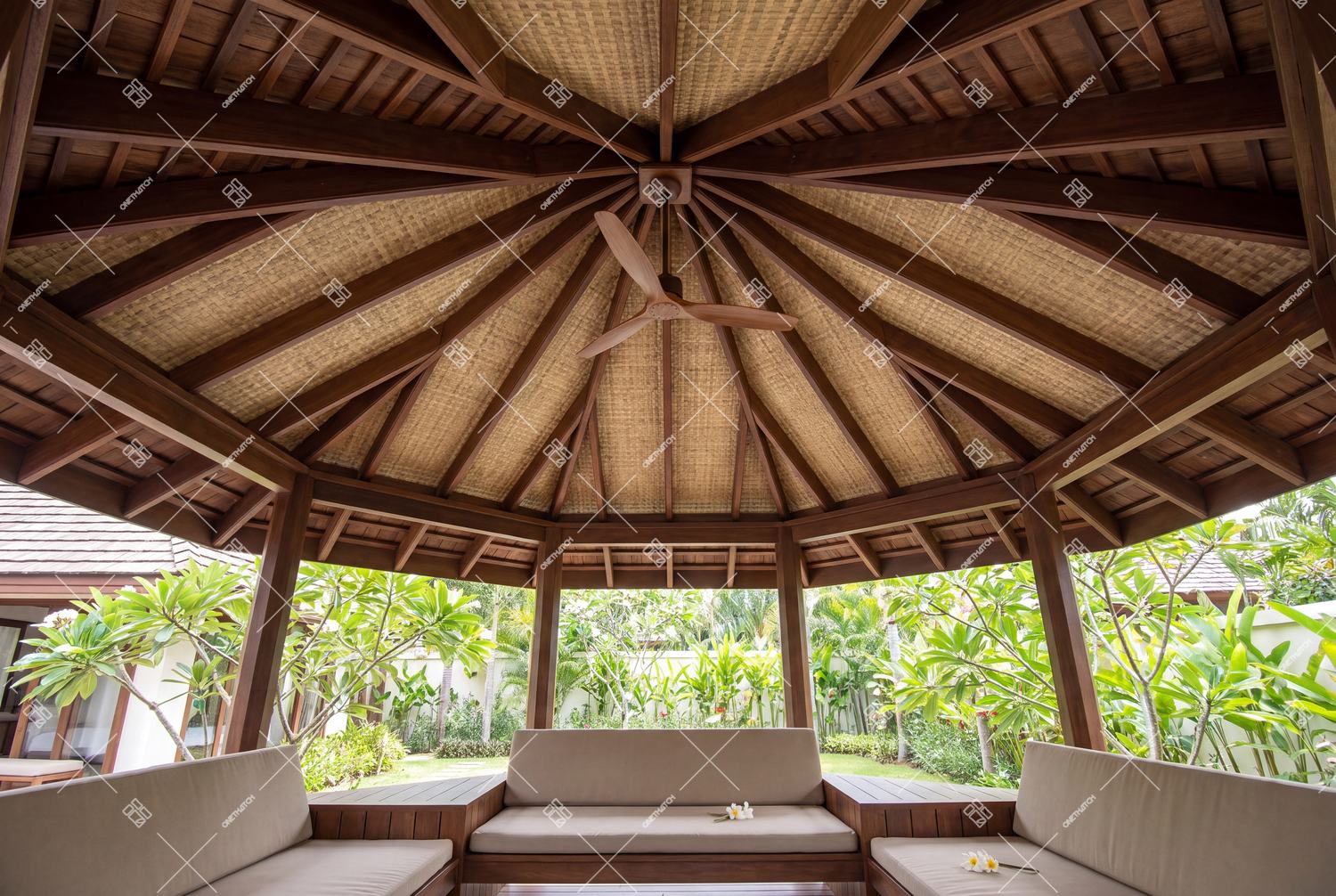
Modern amakan ceiling design
A modern amakan ceiling design uses the weave as a feature, not the whole room. Try a woven coffer framed in dark timber over a dining table, a woven strip running the length of a corridor, or panels set between concrete beams. The result is warm and unmistakably Filipino, yet clean enough for a condominium or a boutique hotel.
Amakan house ceiling design
In a full amakan house ceiling design, the ceiling continues the material of the walls, so the house reads as one woven shell. This is where the amakan house design tradition began: amakan house philippines builds used woven walls, a nipa roof and timber posts, raised off the ground for air. Many families still look for an amakan house design low budget option, because natural panels cost little to buy. The hidden cost comes later, in replacement panels and pest treatment, especially near the sea.
Sawali ceiling design
A sawali ceiling design suits smaller rooms, where its fine twill reads as texture rather than pattern. A sawali ceiling in a bedroom or veranda feels intimate and cool. A bamboo sawali ceiling also pairs well with half-round bamboo trims at the joints.
Amakan bamboo for ceiling: what to plan
If you choose amakan bamboo for ceiling work, plan for ventilation above the panels, a timber frame at every edge, insect treatment before installation and regular inspection. The same applies to every bamboo ceiling design philippines project that uses natural cane, and to any amakan ceiling philippines installation near the coast, where salt air and typhoon humidity work hardest on the weave.
Types of ceiling in the Philippines
Among the types of ceiling in the philippines, homeowners usually choose between:
| Ceiling type | Look | Watch out for |
|---|---|---|
| Gypsum board | Smooth, modern | Water stains after roof leaks |
| Fibre cement board | Flat, durable | Plain unless finished |
| PVC ceiling panels | Glossy, uniform | Plastic look, contains PVC |
| Plywood or wood planks | Warm, natural | Termites, moisture |
| Natural amakan or sawali | Woven, native | Mould, bukbok, fading |
| Synthetic woven mat (HDPE) | Woven, native look | Covered areas only, needs a backing board |
Which ceiling is best for home?
Which ceiling is best for home use depends on the room. Over a kitchen hob, choose a non-combustible board. In bathrooms, a synthetic woven sheet on a moisture-resistant backing board works where natural cane would rot. For living rooms, verandas and resort spaces where you want the native woven look, a synthetic woven sheet on plywood gives the amakan character with far less upkeep than natural cane. The best ceiling is the one that keeps its looks in your climate.
How synthetic woven sheets compare
ONETHATCH® Woven Mat is our answer to the problems of natural weaves. It is hand-woven from 13 mm strands of HDPE synthetic wicker, in a diagonal zigzag that echoes the classic tropical basket weave, and supplied in 1.22 × 2.44 m (4 × 8 ft) sheets, with rolls for large projects.
- No food for pests. There is no plant fibre in the weave for bukbok or termites.
- Built for humidity. The HDPE strands do not soak up water, so the weave stays tight through the rainy season.
- Colour that holds. The weave passed 5,000 hours of ASTM G155 accelerated weathering with no significant colour change.
- Peace of mind. Every sheet carries a 20-year limited warranty.
- Fire-rated option. A fire-retardant version, rated ASTM E84 Class A that has also passed NFPA 286, is made to order for commercial interiors.
It belongs on walls, ceilings and bar fronts, indoors or in covered outdoor areas such as verandas and kubo ceilings under a roof. It is a ceiling finish, not a roof, and not for floors or countertops.
Bamboo ceiling panels philippines: sheet or panel?
Installers looking for bamboo ceiling panels philippines projects can work two ways. Glue the mat to 4–6 mm plywood on site, then staple the board to the joists, a staple every 30 cm (12 in). Or laminate the sheets to plywood in the workshop first, so each board goes up like a ready-made panel. Staples only, never nails. Edge the boards with our synthetic bamboo half-rounds for the framed look of a traditional amakan ceiling.
Ceiling cost Philippines: what drives the price
As a guide, ONETHATCH Woven Mat costs roughly USD 15–30 per m² EXW, depending on quantity and weave pattern, and standard Teak matting is in stock. Your final ceiling cost philippines depends on more than the sheet itself:
- the ceiling area and how much cutting the layout needs;
- the quantity and weave pattern, plus the colour (stocked colours versus made to order);
- standard or fire-retardant version;
- backing board, adhesive, staples and trims;
- freight to your island and port.
Send us your floor plan and we will prepare the quantities and a quote, with free samples so you can see the weave under your own light first.
Buying bamboo matting in the Philippines
Searching for bamboo matting philippines suppliers usually leads to local weavers selling natural amakan and sawali. They are a good choice for a short-term, low-cost build. For hotels, resorts and homes that need a woven ceiling to keep its looks, ONETHATCH ships synthetic matting directly from our own production to the Philippines and more than 80 countries.
Among bamboo matting philippines manufacturers, we offer something different: a family manufacturer since 1996, ISO 9001 certified since 2010, with a UV stabiliser system selected together with BASF stabilizer engineers. If you are looking for bamboo matting philippines for sale in sheets for a single kubo or in rolls for a resort, we quote both, with quantity take-off from your drawings.
FAQ
What is the difference between amakan and sawali?
Amakan is a broad, sturdy weave of wide bamboo strips, while sawali is a finer twilled weave of flattened bamboo. Both are natural woven split-bamboo mats used for walls and ceilings in the Philippines.
What is the best ceiling for a nipa hut?
For a nipa hut, a woven ceiling between exposed rafters gives the most authentic look. Natural amakan is traditional; a synthetic woven sheet on plywood gives the same look without mould or bukbok, as long as the hut has a roof over it.
Can ONETHATCH Woven Mat replace sawali on a veranda?
Yes, on a covered veranda. Glue the mat to plywood, staple the board to the joists, and trim the edges with half-round bamboo.
Is synthetic woven matting a roofing material?
No. It is a wall and ceiling finish that always sits under a roof. For the roof itself, see our synthetic thatch.
Bring the native weave home
The amakan and sawali tradition deserves to last. Request free samples of ONETHATCH Woven Mat, send your plan for a quote, and give your ceiling the woven warmth of the bahay kubo, built for modern life.
 7 reasons to choose synthetic palm thatch
 Kenninji-Gaki, the classic Japanese bamboo fence
 How to install ONETHATCH PALM (NIPA), step by step
 English
 Japanese
 Arabic
 Spanish
 French
 Portuguese
 Italian
 German
 Chinese (China)
 Thai
 Vietnamese
 Indonesian
 Korean
 Chinese (Taiwan)
 Russian