

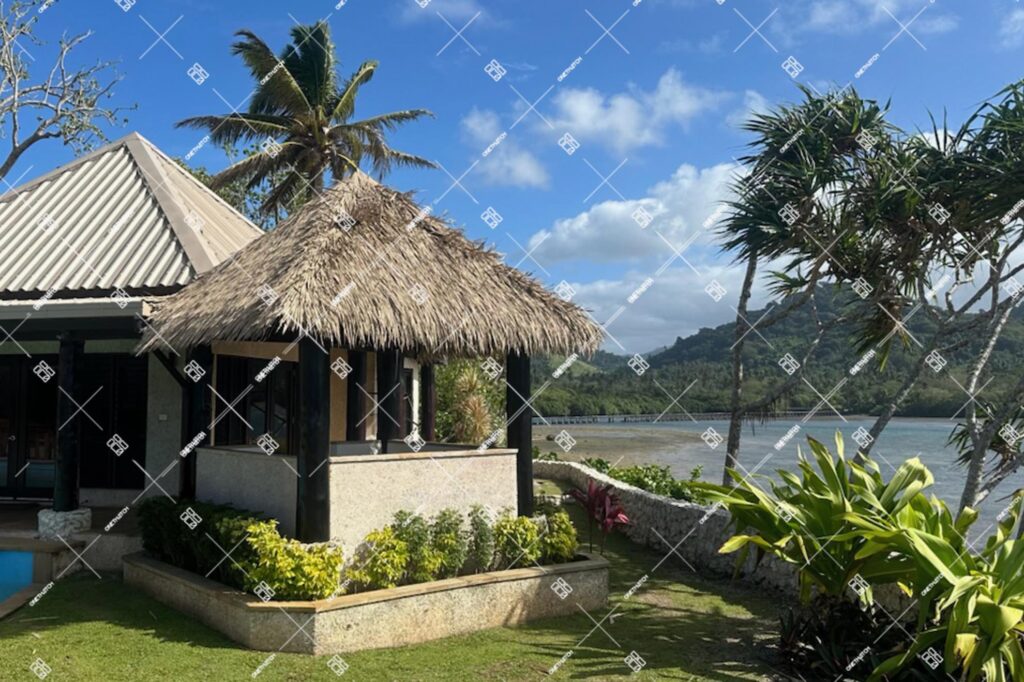
Quick answer: No thatch is fireproof, but fire-retardant thatch slows flame spread. ONETHATCH FR PALM and FR REED are rated Class A to ASTM E108, the highest class of that roof-covering fire test, with the retardant built into the material rather than sprayed on. Standard (NFR) versions carry no fire rating. Specify the FR version by name and check your local requirements.
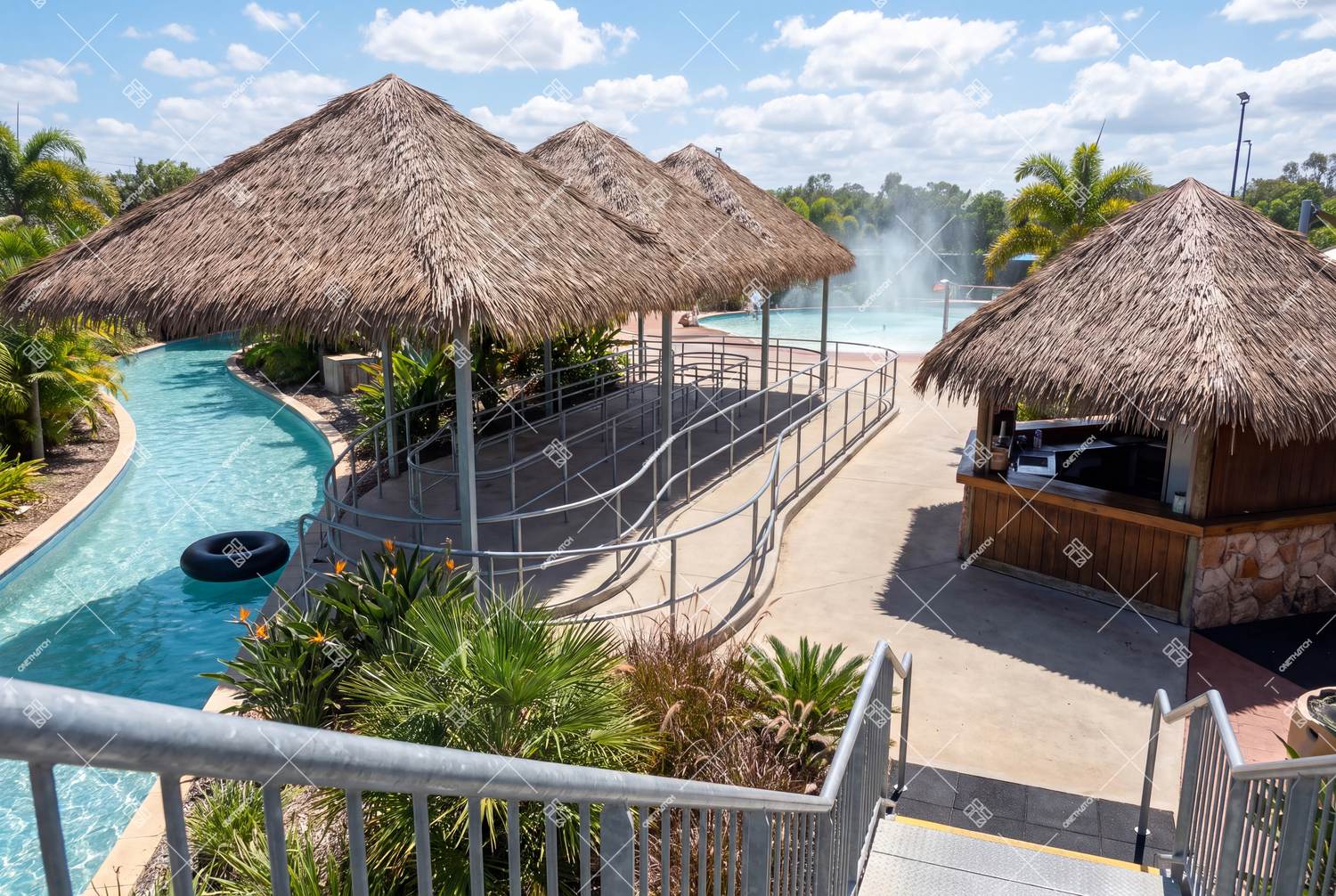
Is Synthetic Thatch Fire-Resistant?
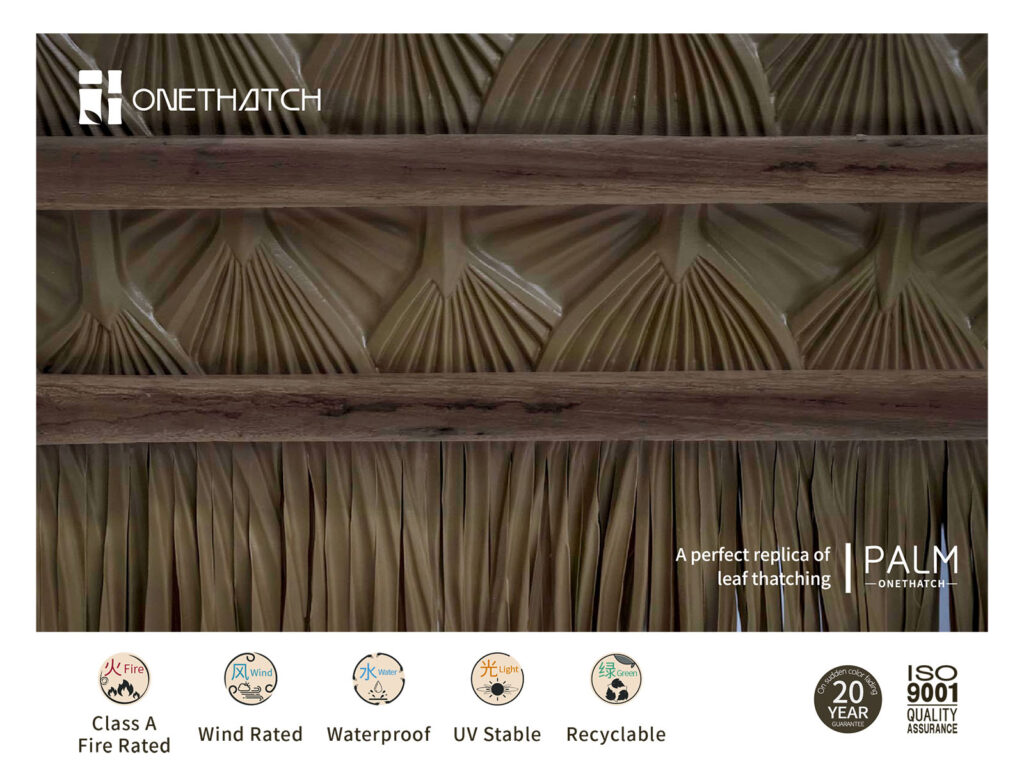
It depends on the product: only a tested product should be called fire-resistant, and a thatch fire-retardant spray is not the same as a fire rating. Fire-rated (FR) synthetic thatch is made with flame-retardant material and tested to a roofing fire standard; non-rated (NFR) synthetic thatch is not. The FR version of ONETHATCH PALM is rated Class A to ASTM E108, the highest fire class for roof coverings (Intertek report 220927005SHF-001). FR REED and FR STRAW are also rated Class A to ASTM E108.
This is the most common question we hear from resort owners, architects and insurers, because natural palm and grass thatch burns readily and is often restricted by fire authorities. Synthetic thatch fire-rated to Class A (the FR version) lets resorts, restaurants, theme parks and palapa bars keep the thatched look with a documented fire rating.
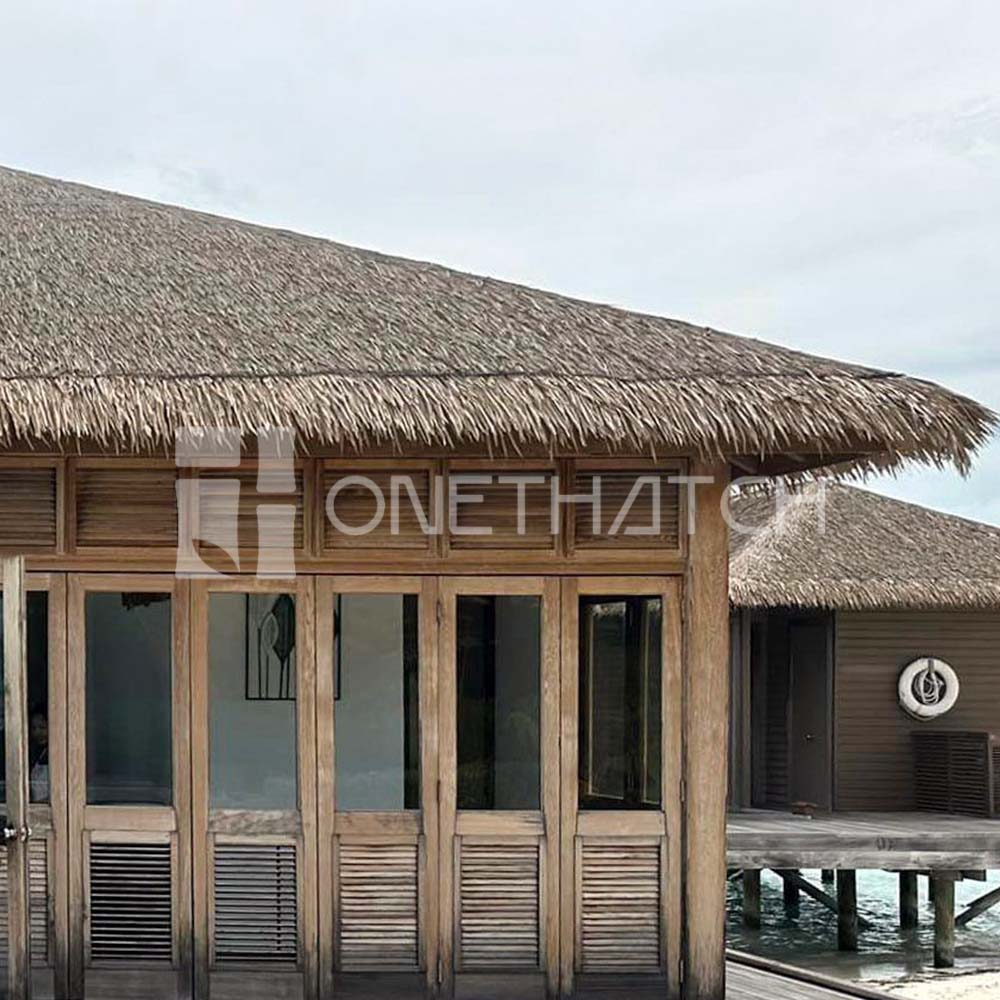
What Does Class A Fire Rated Mean?
ASTM E108 (equivalent to UL 790) is the standard fire test for roofing materials in the United States. It classifies roof coverings as Class A, B or C, and Class A is the highest rating: the roof covering is effective against severe fire exposure.
A fire rating applies to the product and assembly that were tested. When you compare fire-rated thatch products, ask for the test report itself and check the standard, the class, the laboratory, the report number and which version of the product was tested. For ONETHATCH, the Class A rating applies to the FR version of ONETHATCH PALM, and the report is available for your permit and insurance submissions.
What we hold, and what we don’t: fire tests country by country
A fire rating is only useful if it is the one your authority asks for. So here is the full picture, in one place: the test ONETHATCH holds, and the national tests and classes it does not.
What we hold. The FR (fire-retardant) versions of ONETHATCH PALM and REED are rated Class A to ASTM E108, the US fire test for roof coverings (Intertek report 220927005SHF-001). The retardant is built into the formula, not sprayed on, so it cannot wash off. The standard NFR versions have no fire rating.
| Country or region | Standard or rule | What it covers | ONETHATCH status |
|---|---|---|---|
| USA and international specs | ASTM E108 (UL 790) | Fire performance of roof coverings | Held: Class A, FR PALM and FR REED (Intertek 220927005SHF-001) |
| Germany | DIN 4102-7 / “harte Bedachung” | Resistance of roofs to flying sparks and radiant heat | Not held |
| Europe | EN 13501-5, BROOF(t1) and other BROOF classes | External fire performance of roofs | Not held |
| Europe | EN 13501-1 | Reaction to fire of building products | Not held |
| China | GB 8624 (A级 / B1) | Combustibility classes of building materials | Not held |
| Japan | 不燃材料 approval / Building Standards Act Article 22 areas | Non-combustible materials; roofs in fire-prevention areas | Not held |
| Russia | НГ (non-combustible) class | Non-combustibility of building materials | Not held |
| South Africa | SANS 10400-T | Fire rules in the national building regulations, incl. thatched roofs | No SANS-specific classification; the local authority decides how the ASTM E108 report is considered |
| USA | UL 1897 | Wind uplift of roof systems (not a fire test) | Not held |
Why list what we don’t hold? Because a clear “no” saves you weeks. If your authority asks for one of these, you will know before you order, and you can discuss whether the ASTM E108 report or a different roof build is the right path.
Natural thatch and boundary distances
Many building codes treat natural thatch as a “soft” roof covering and ask for larger distances to boundaries and neighbouring buildings, as German state building codes do for reed roofs. A synthetic roof with no recognised national classification may be treated the same way, so ask your authority how it will classify the roof before you design the site plan.
Synthetic Thatch vs Natural Thatch
| Feature | Natural thatch (palm or grass) | ONETHATCH PALM, FR version |
|---|---|---|
| Fire | Burns readily; needs repeated thatch fire-retardant sprays | Class A to ASTM E108 (Intertek) |
| Fire documentation | Usually none | Test report available for permit and insurance submissions |
| Re-thatching | Every few years in tropical climates | None; 20-year limited warranty |
| Colour in the sun | Bleaches to grey | Passed 5,000 h ASTM G155, no significant colour change |
| Maintenance | Pest treatments and thatch fire-retardant reapplication | Occasional rinse |
Why Resorts and Restaurants Choose Fire-Rated Synthetic Thatch
- Documented fire rating. The Class A test report for the FR version gives fire authorities and insurers something concrete to review when they assess a resort thatch roof.
- Guest and staff safety. Restaurants, bars and villas often have cooking, heaters, candles and torches close to the roof, so a fire-rated roof covering such as FR artificial thatch matters.
- The look guests expect. Engineered thatch keeps the tropical palapa thatch look without the risk of a leaf roof.
- Lower running costs. No re-thatching and no thatch fire-retardant sprays to reapply; a 20-year limited warranty covers rot, delamination, UV degradation and, in the first 10 years, base-color fading.
- Material. An eco-friendly choice: PVC-free, recyclable HDPE made in a solar-powered factory.
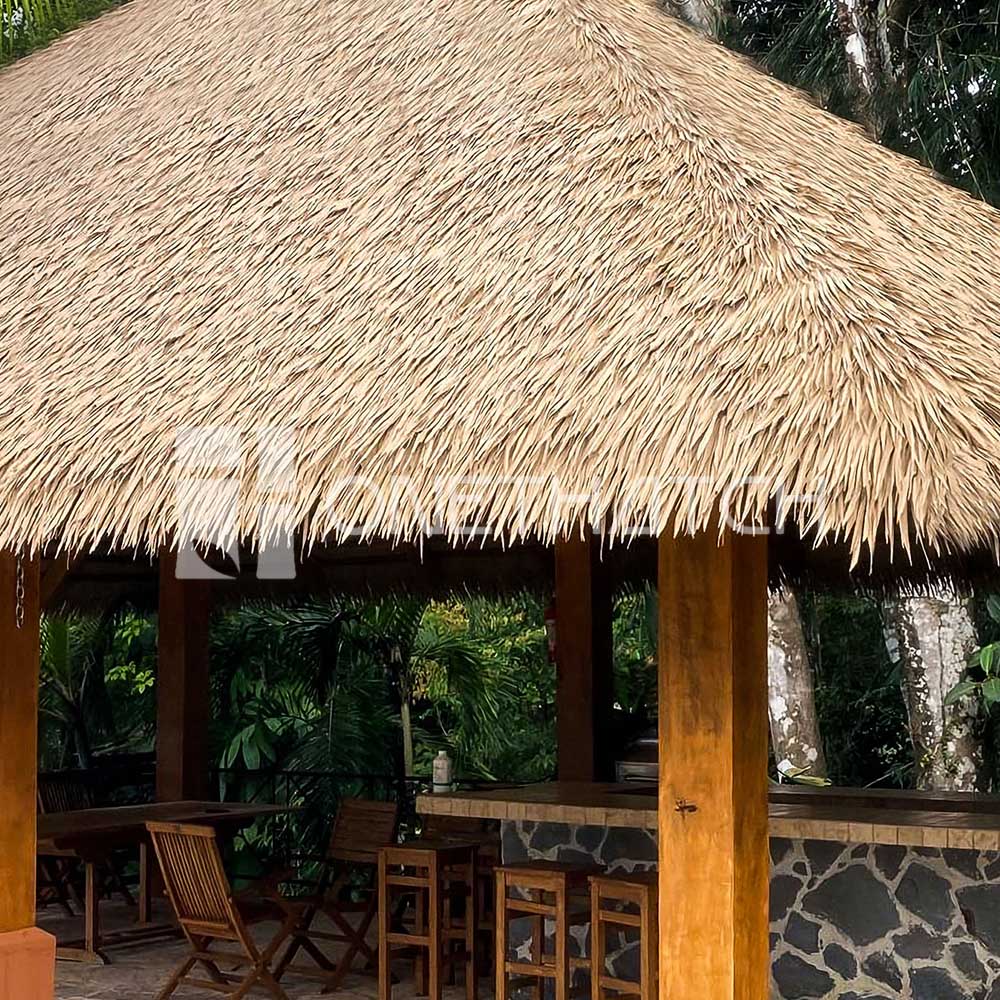
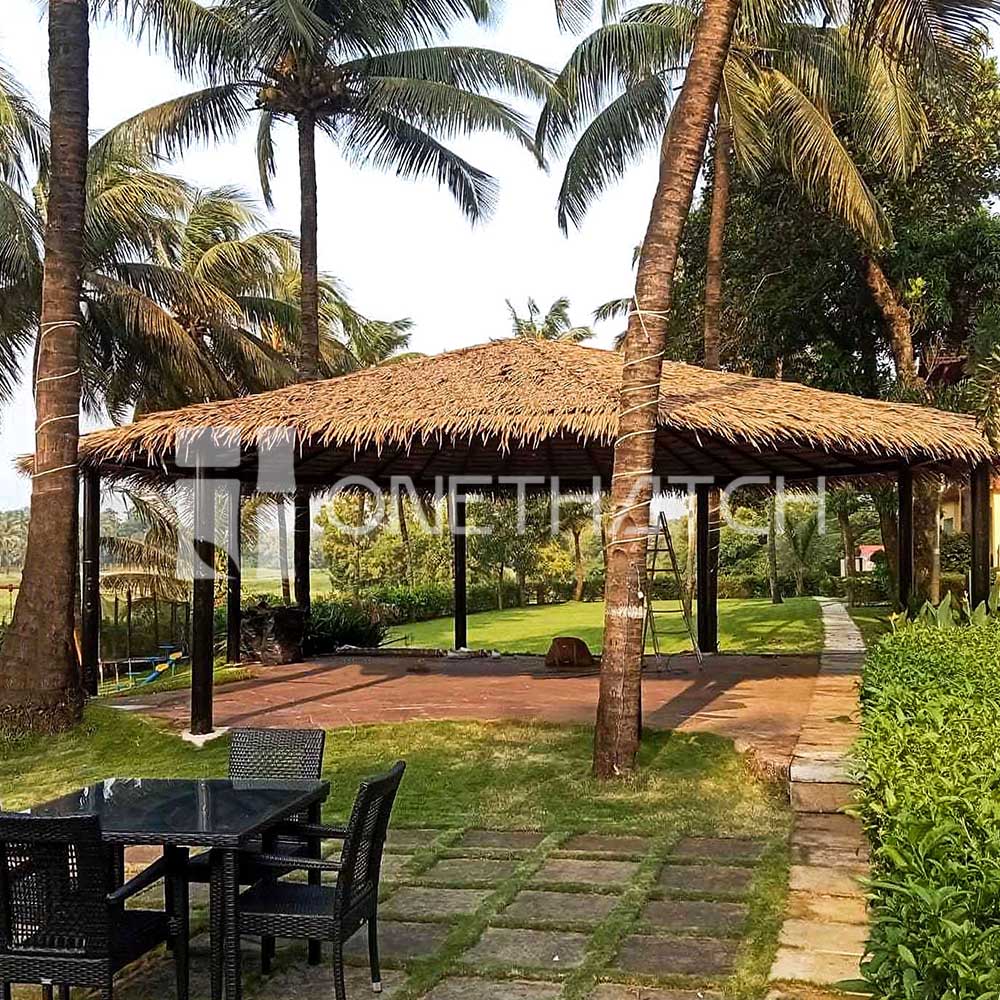
Applications for Class A Fire Rated Synthetic Thatch (FR Version)
- Palapas and beach bars: the classic island look of thatched roofs, with a documented fire rating.
- Resort villas, cabanas and bungalows: fire-rated thatch over guest rooms, where fire safety matters most.
- Restaurant roofs: thatched dining pavilions and outdoor kitchens.
- Theme parks and waterparks: themed roofs over queues, shops and food outlets.
- Hotels, eco-lodges and tourism developments: any commercial project where the fire authority reviews the roof covering.
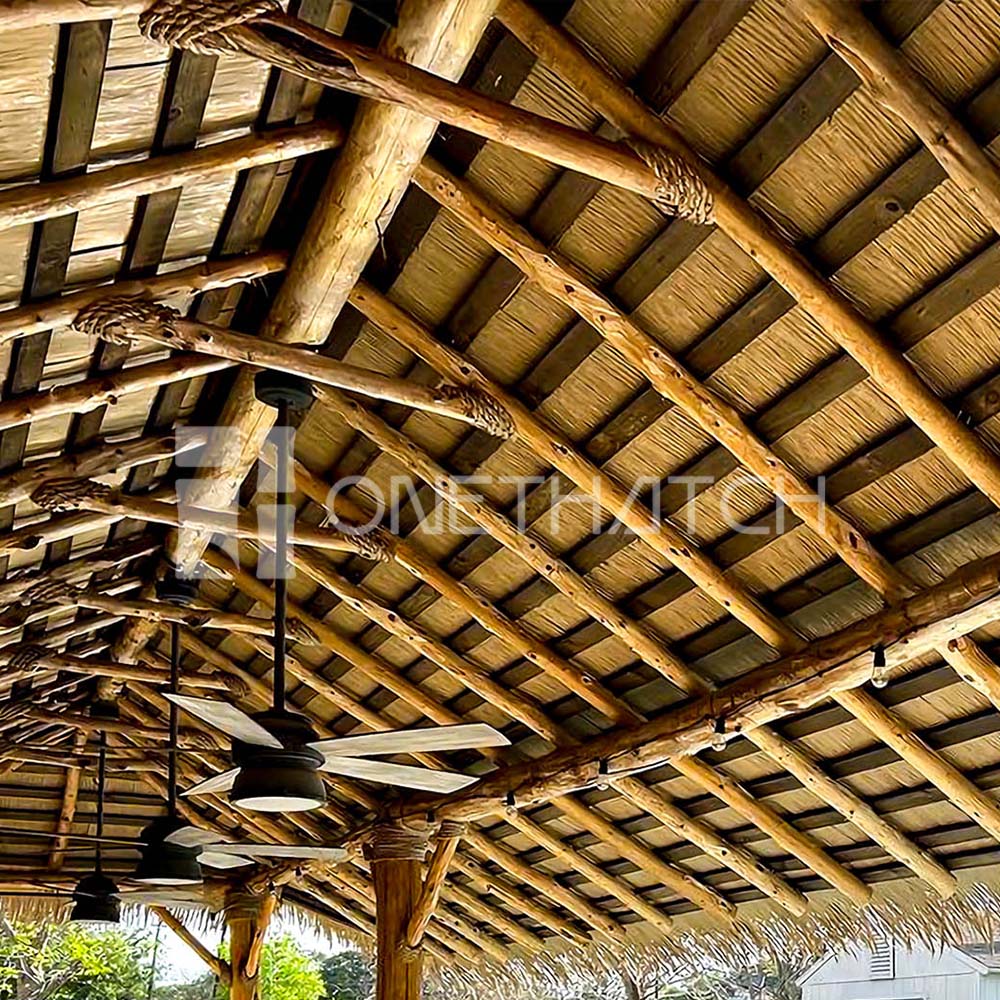
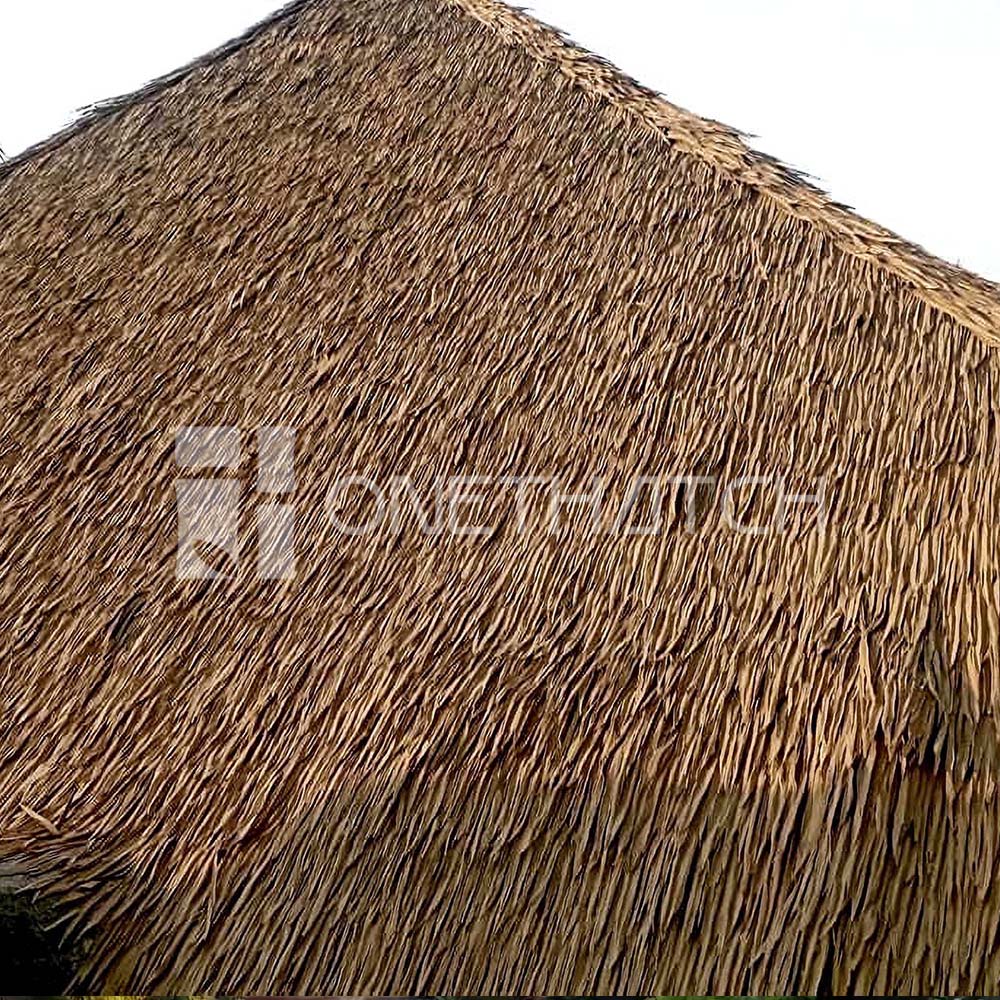
How to Choose a Fire-Rated Synthetic Thatch
- Ask for the test report. Check the standard (ASTM E108), the class (A), the laboratory, the report number and which product version was tested.
- Talk to your fire authority and insurer early. Confirm what they need to see for your project and location, and whether a thatch fire-retardant spray is enough or a tested fire rating is required.
- Check the warranty scope. Look for a written warranty and what it covers; ONETHATCH thatch carries a 20-year limited warranty covering rot, delamination, UV degradation and, in the first 10 years, base-color fading.
- See a sample. Compare the texture and colour with the look you want.
- Install to specification. Fix the panels with stainless roofing screws as the manufacturer specifies, so the roof performs as tested. Compare styles in our synthetic palm thatch range.
The Bottom Line: A Fire Rating, Not Just a Thatch Fire Retardant
If you are planning a resort villa roof, a restaurant renovation or palapa thatch for a beach bar, the question to ask is not just “is it synthetic?” but “is it fire-rated, and can you show me the report?”. The FR version of ONETHATCH PALM is rated Class A to ASTM E108, carries a 20-year limited warranty and is moulded from real palm leaves. Send your roof drawings or photos through our commercial enquiry form and our engineer will calculate the quantities.
FAQ
Is synthetic thatch fire-resistant?
Only the fire-rated versions. The FR version of ONETHATCH PALM is rated Class A to ASTM E108 (Intertek report 220927005SHF-001). An NFR version, with no fire rating, is also available where no rating is required.
Is a thatch fire-retardant spray the same as a fire rating?
No. A thatch fire retardant is a treatment applied to a natural roof and renewed from time to time, while a fire rating is a lab result for a specific product and assembly. The FR version of ONETHATCH PALM is made with flame-retardant material and rated Class A to ASTM E108, so nothing needs re-spraying.
Why do insurers and fire authorities ask for a test report?
A report shows which standard the roof covering was tested to and the class it achieved, so they can assess the risk. Requirements vary by country and insurer (in South Africa, for example, thatched roofs fall under the fire rules of SANS 10400-T), so confirm them early in the project.
How long does synthetic thatch last compared with natural thatch?
Natural palm or grass thatch has to be re-thatched every few years in tropical climates. ONETHATCH synthetic thatch carries a 20-year limited warranty covering rot, delamination, UV degradation and, in the first 10 years, base-color fading.
Can fire-rated synthetic thatch be used for commercial projects?
Yes. Resorts, restaurants, hotels and theme parks use it; see synthetic thatch roofing projects in Costa Rica, the Maldives, Mexico and the Caribbean.
How is ONETHATCH PALM (NIPA) installed?
The panels are fixed in overlapping courses to battens with stainless roofing screws, never nails or staples. See our ONETHATCH PALM (NIPA) installation guide.
Is synthetic thatch non-combustible?
No. Synthetic thatch is made of HDPE, a plastic, and no version is non-combustible. What the FR version offers is a tested fire rating: FR PALM and FR REED are Class A to ASTM E108. We never describe any thatch, natural or synthetic, as unable to burn.
Does a reed roof burn?
Yes, a natural reed roof is combustible plant material and burns readily once alight, which is why many codes restrict it. Synthetic reed also needs the right version: the FR version of ONETHATCH REED is rated Class A to ASTM E108, while the standard NFR version has no fire rating.
Can natural thatch or Cape reed be made fire-retardant?
Natural thatch, including Cape reed, can be treated with a thatch fire retardant, which slows ignition, but it does not make the roof non-combustible, and the treatment has to be renewed as weather wears it away. It also does nothing against rot. A synthetic FR panel has the retardant built into the formula from the start, so there is nothing to re-apply.
How do I protect natural straw from rot and fire?
Natural straw and grass need two separate treatments, one against rot and fungi and one against fire, and both have to be renewed over time. Synthetic thatch needs neither: HDPE does not rot, and the FR version carries its fire retardancy in the material itself.
Is there a fire-retardant alang-alang (grass) look?
Yes: our STRAW range, which includes the BALI alang-alang look, is available in an FR version. Ask us to confirm the current fire rating for STRAW before you specify it.


7 reasons to choose synthetic palm thatch
Kenninji-Gaki, the classic Japanese bamboo fence
How to install ONETHATCH PALM (NIPA), step by step