


From garden plant supports to bamboo screening and serene Asian garden design, bamboo signifies strength, calm and success. So which should you specify, natural or synthetic? In short: natural culms bring living texture but crack, turn grey and need treatment, while ONETHATCH synthetic poles keep the look with no sealing, varnishing or pest treatments. Below, we compare natural and synthetic poles side by side, explain Tonkin, moso and guadua, and share why we make the alternative.
This Is Why We Create Artificial Bamboo Poles
Yet natural solid bamboo has its challenges. Over time, natural poles lose their colour and begin to decay, and your clients must replace them again and again.
That’s why ONETHATCH created Faux Bamboo Poles: the warmth of real bamboo, without the worry. Every pole is moulded from real bamboo in ASA resin, a weather-resistant engineering plastic, so each node and grain line is captured and the base colour runs all the way through. In warm Sundried, our artificial bamboo keeps the feel of living bamboo. These plastic bamboo poles carry every node of the original, bringing height and a touch of Asian calm to interiors, terraces and resort gardens.
Natural vs Synthetic Poles at a Glance
The short answer: natural poles win on origin, synthetic poles win on consistency and care.
| Point | Natural poles (Tonkin, moso, guadua) | ONETHATCH synthetic poles |
|---|---|---|
| Material | Harvested culms, dried and often chemically treated | ASA resin moulded from real bamboo, colour moulded through |
| Cracking and rot | Splits as it dries; rots where it stays wet | 20-year limited warranty covering rot and delamination |
| Insects and mould | Starch attracts borers; mould in humid shade | No pest treatments needed |
| Colour outdoors | Weathers to silver-grey in sun and rain | Passed 5,000 hours of ASTM G155 accelerated weathering with no significant colour change |
| Care | Periodic re-sealing or re-varnishing; borax or boron treatment before use | An occasional rinse with water and mild soap |
| Fire | Untreated culms are combustible | Stock not fire-rated; FR version, Class A to ASTM E84, to order |
| Size | Varies pole to pole and tapers from base to tip | Set diameters from 25 to 75 mm; threaded or one-length |
Types of Bamboo Poles: Tonkin, Moso, Guadua and More
Natural poles are sold under many names. This glossary explains the common ones; every entry describes natural bamboo, not our synthetic poles.
| Name | What it means |
|---|---|
| Moso poles (Phyllostachys edulis) | A large timber bamboo and a common source of imported bamboo poles, including large moso bamboo poles |
| Elephant leg bamboo poles | A trade name for extra-thick natural poles, used for bold feature posts |
| Tonkin cane (Pseudosasa amabilis) | Also called tea stick bamboo: straight, thick-walled culms with little taper. Tonkin bamboo poles are sold as bamboo canes, bamboo stakes and bamboo sticks, and split Tonkin is the traditional material for tonkin cane fly rod poles |
| Guadua (Guadua angustifolia) | A thick-walled South American giant; guadua bamboo poles are the region’s classic bamboo poles for tropical architecture |
| Tam vong bamboo | A Southeast Asian bamboo with thick, dense culms |
| Iron bamboo, solid bamboo poles | Names used for dense, thick-walled culms. Tonkin bamboo vs solid bamboo comes down to weight: Tonkin poles are hollow and light, solid poles heavy |
| Tre gai bamboo | A thorny bamboo known by its Vietnamese name; tre gai bamboo poles suit rustic fencing |
| Giant timber bamboo | A common name for several large species grown in warm climates, including the USA, where giant timber bamboo poles are sold as homegrown bamboo poles or bamboo poles grown in USA |
| Java black bamboo | A naturally dark-skinned species |
| Black speckled bamboo poles, spotted leopard bamboo poles | Poles with natural dark mottling on the skin |
| Polished bamboo poles | Buffed to a soft sheen; polished black bamboo poles are the dark version |
| Natural dried bamboo poles | Air-dried to a pale blonde with no added finish |
| Flamed bamboo poles | Also sold as hand flamed bamboo or flame cured bamboo poles: the skin is torched to darken it |
| Split-sanded bamboo | Culms halved and sanded smooth |
| Dyed green bamboo stakes, bamboo flower stakes, 4ft natural bamboo poles, bamboo tree guard | Garden supplies for supporting plants, rather than design poles |
Why Do Natural Poles Crack, Rot or Go Grey?
Because they are plant fibre. Natural bamboo culms shrink as they dry, and the hard outer skin dries differently from the softer inner wall, so it is widely accepted that all bamboo poles will crack to some degree. Slow drying and venting the nodes help prevent the bamboo pole from splitting, but cannot stop it.
Sunlight and rain break down the surface, which is why owners find their bamboo has gone grey after time outdoors. Starch in the fibres feeds borers, so a bamboo insect infestation often starts unseen, and in humid shade mouldy bamboo is common. Preventing bamboo pole rot means keeping ends off the ground, capping cut tops and renewing finishes.
Borax, Boron and Drying: How Natural Poles Are Treated
Bamboo preservation and treatment starts at harvest. Fresh cut green bamboo is full of sap and starch; leaching bamboo in water draws some of that starch out. Chemical bamboo preservation usually means a bath of boric acid and borax, and boron-treated bamboo resists borers far better than untreated bamboo poles.
Drying bamboo poles comes next: air drying bamboo under cover is slow and gentle, while kiln drying bamboo is faster. Even treated bamboo poles need an outdoor finish, renewed over time.
ONETHATCH poles skip every one of these steps: a moulded ASA pole has no starch, sap or drying stage.
Artificial Bamboo Poles for Sale: Colours, Finishes and Uses
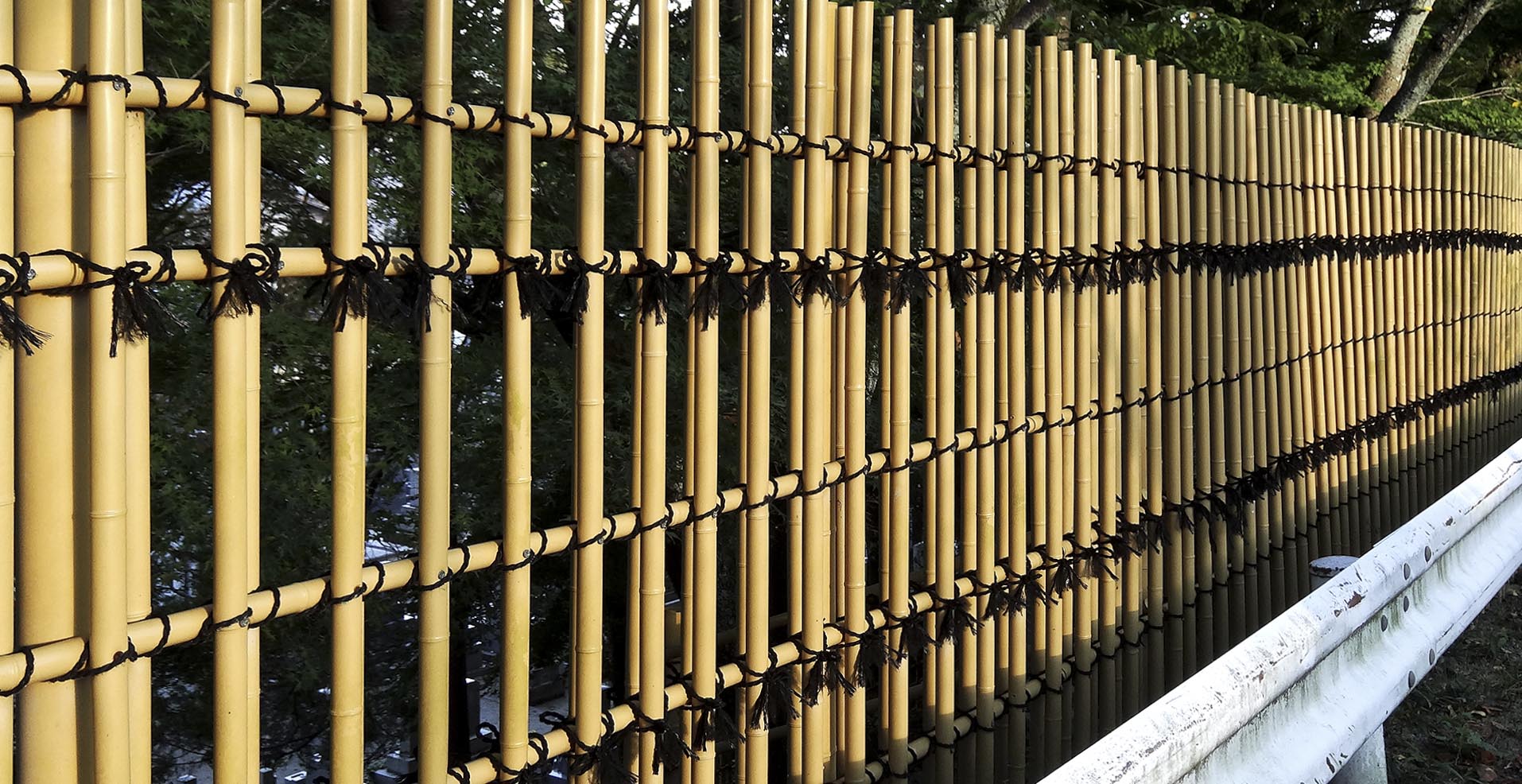 Our poles are coloured after natural solid bamboo sticks: warm Sundried is the stock colour, while Green, Carbonized and black bamboo poles are custom colours for commercial projects, and some colours add a hand-painted weathering texture for a lived-in look. Designers use them for faux ceiling rafters, fencing infill and custom privacy screens, pergola details, column wraps, signage and palapa-style posts fixed around a steel column. For the full sizes and specs of each synthetic bamboo stem, or our split poles and half-rounds, contact our team.
There is something fresh and captivating about bamboo that makes it a landscaping favourite. Our Synthetic Bamboo Poles collection brings that character to places natural culms struggle: poolsides, coastal terraces, water parks and busy hospitality spaces. Whether you want structure, privacy or calm, synthetic bamboo poles carry the look without re-varnishing, sealing or pest treatment.
Bamboo Pole Size Guide: Which Diameter and Length to Specify
Specify our threaded poles in 40, 50 or 75 mm diameter, stocked in Sundried, or in 25 and 65 mm made to order. Each threaded section is 508 mm (20 inches) long and screws into the next, so our Artificial Bamboo Poles assemble to whatever height your design needs. One-length poles run up to 6 m for long, uninterrupted lines, while split poles and half-rounds finish walls and edges. For a natural rhythm, pair slim 25 mm accents with medium diameter poles of 40 to 50 mm.
How much do bamboo poles taper? A natural culm narrows from base to tip, so a long natural pole changes diameter along its length. Our threaded poles are ordered by diameter and every 508 mm section screws into the next, so a tall run keeps the size you specify.
Our fake bamboo poles feel at home in theme parks, exhibitions, retail, hospitality, airports and colleges, and they look remarkably real because each begins as a mould of real bamboo. They are dramatic, durable and virtually maintenance-free: no sealing, staining, varnishing or pest treatments, just an occasional rinse with water and mild soap.
How Long Does Bamboo Last Outdoors, Natural or Synthetic?
It depends on the material. A natural pole’s outdoor life varies with species, treatment and exposure, and UV protection for bamboo poles means a UV-filtering varnish that must be renewed.
For our poles, UV resistance and fade performance are tested, not assumed: the material passed 5,000 hours of ASTM G155 accelerated weathering at Micom Laboratories (Canada) with no significant colour change. Every ONETHATCH pole carries a 20-year limited warranty covering rot, delamination, UV degradation and, in the first 10 years, base-colour fading. Read more in our guide to synthetic bamboo weathering and UV resistance, and register your project under the synthetic bamboo warranty.
Bamboo Poles for Outdoor Structures: Decorative Skin, Steel Core
Our poles are decorative, not load-bearing. Where a post must carry weight, a metal tube goes inside the pole, or the pole is fixed around a steel or concrete column, so the frame does the work while the artificial bamboo brings the warmth. Contact us with your drawings and we will suggest the right build-up.
Bamboo poles vs wood poles
Timber is the other natural option. Eucalyptus poles and lodge pine poles are solid wood, heavier than hollow bamboo, with a smoother, rounder profile; eucalyptus poles for pergolas are often peeled for a pale finish, and peeled vs unpeeled eucalyptus poles differ in both look and upkeep. Like natural bamboo, both need sealing and regular checks outdoors.
On Australia’s Gold Coast, Solana, a luxury oceanfront residence in Burleigh Heads, uses ONETHATCH poles for a relaxed tropical feel. Explore our synthetic bamboo range or see how synthetic bamboo compares with natural fencing.
Request Samples or a Quote
Hold a pole in your hand before you specify. Tell us the diameters, colours and lengths your design calls for, and we will send samples and a tailored quotation: request a quote.
 English
 Japanese
 Arabic
 Spanish
 French
 Portuguese
 Italian
 German
 Chinese (China)
 Thai
 Vietnamese
 Indonesian
 Korean
 Chinese (Taiwan)
 Russian