


A woven bamboo ceiling turns a dining room into a getaway. In a restaurant, hotel lobby or beach club, that same ceiling also has to satisfy the fire marshal. Fire-rated bamboo matting lets you have both: the warm, hand-woven look your guests remember, and the named test results your inspector asks for.
This guide explains what ASTM E84 Class A and NFPA 286 mean, when building codes call for them, and how to specify the FR (fire-retardant) version of the ONETHATCH® Woven Mat.
Is Bamboo Flame Resistant?
Natural bamboo is not flame resistant: like wood, palm leaf and grass, it burns. Thin, dry woven strips catch faster than a solid pole, which is why untreated natural mats are a concern on ceilings in busy public spaces. For roofs, see how Class A fire-rated synthetic thatch handles the same question overhead.
We say it plainly: the standard ONETHATCH Woven Mat carries no fire rating either. When your project needs one, you specify the FR version, made to order.
What Makes Our FR Version Different: Class A FR Matting
The FR Woven Mat is tested to two standards: ASTM E84 with a Class A result, and NFPA 286. It keeps everything designers love about the standard mat:
- Hand-woven HDPE synthetic wicker in 13 mm strands, with the texture and depth of a real woven mat.
- 1.22 × 2.44 m (4 × 8 ft) sheets, or 1220 mm × 50 m rolls for large ceilings.
- 5,000 hours of ASTM G155 accelerated weathering with no significant colour change (Micom MI-25-17428-1).
- A 20-year limited warranty, from an ISO 9001-certified maker in business since 1996.
A factory-made FR product, not an on-site spray. The FR Woven Mat is made and tested as a fire-retardant product, so your team never has to apply, track or renew a treatment on site. That is the difference between Class A FR matting and a natural mat that has been treated after weaving.
ASTM E84 and NFPA 286, in Plain Words
ASTM E84 (the “tunnel test”) measures how fast flame travels across a material and how much smoke it gives off. Results are grouped by flame spread index:
| Class | Flame spread index | What it usually means |
|---|---|---|
| A | 0–25 | The highest class; accepted in the most demanding locations |
| B | 26–75 | Accepted in some rooms and corridors |
| C | 76–200 | The most limited class |
For each class, the smoke-developed index must also stay at or below 450.
NFPA 286 (the “room-corner test”) lines the walls and ceiling of a full-size room with the material and exposes it to a fire in one corner. It shows how the finish behaves as a real room heats up, including whether fire spreads to the room’s edges or reaches flashover. Many codes accept NFPA 286 as an alternative route for interior finishes, and some inspectors ask for it on textured or woven materials.
When Does a Code Call for Fire-Rated Bamboo Matting?
Most commercial projects in the USA follow the International Building Code, and the IBC interior finish rules (Chapter 8) set the required class for wall and ceiling finishes. The class you need depends on three things:
- Occupancy. Restaurants, bars and nightclubs (assembly), hotels (residential) and shops each have their own requirements.
- Location. Exit stairways and exit passageways are strictest, then corridors, then rooms and enclosed spaces.
- Sprinklers. A fully sprinklered building is often allowed one class less strict.
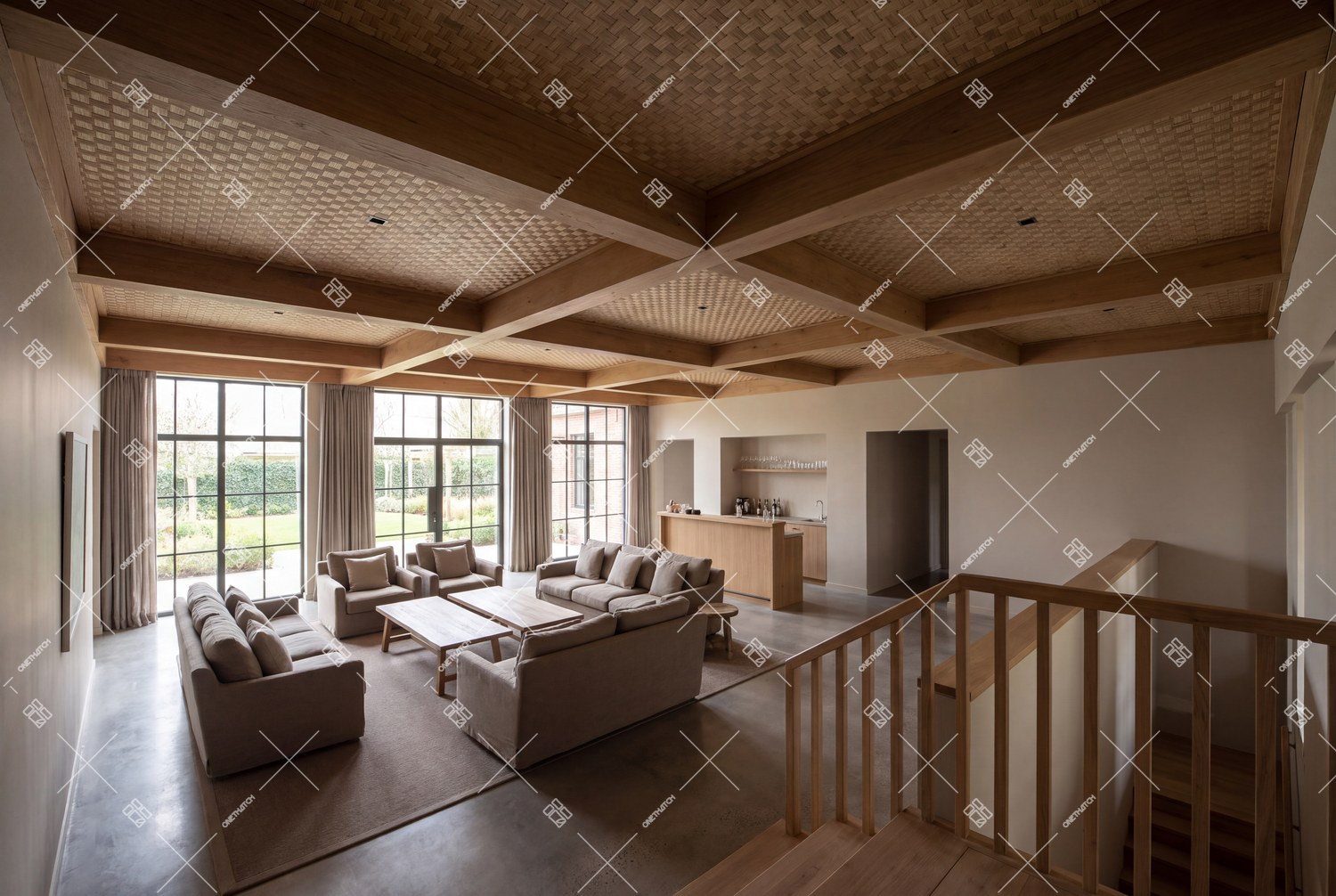
About trim and decorative allowances. The IBC limits combustible interior trim, and certain decorative materials, to a limited share of the wall or ceiling area they are attached to, with different rules in sprinklered buildings. A woven ceiling or a full feature wall is a finish, not trim, so plan on the rated version.
Local codes and the authority having jurisdiction always have the final word. Our advice: specify the FR version from the start, ask us to confirm the test standards and results for your submittal, and let your code consultant confirm the class.
Fire-Rated Woven Bamboo Ceiling Material for Restaurants and Hotels
Ceilings are where fire-rated woven bamboo ceiling material matters most, because flame and heat rise there first. The FR Woven Mat brings a tropical ceiling to:
- Restaurant and bar ceilings, where open kitchens and table candles make inspectors look up.
- Hotel lobbies and corridors, where woven texture softens long, hard spaces.
- Beach clubs and cabanas, in covered outdoor areas under a roof.
- Theme-park queues and themed retail, where immersion meets strict public-space codes.
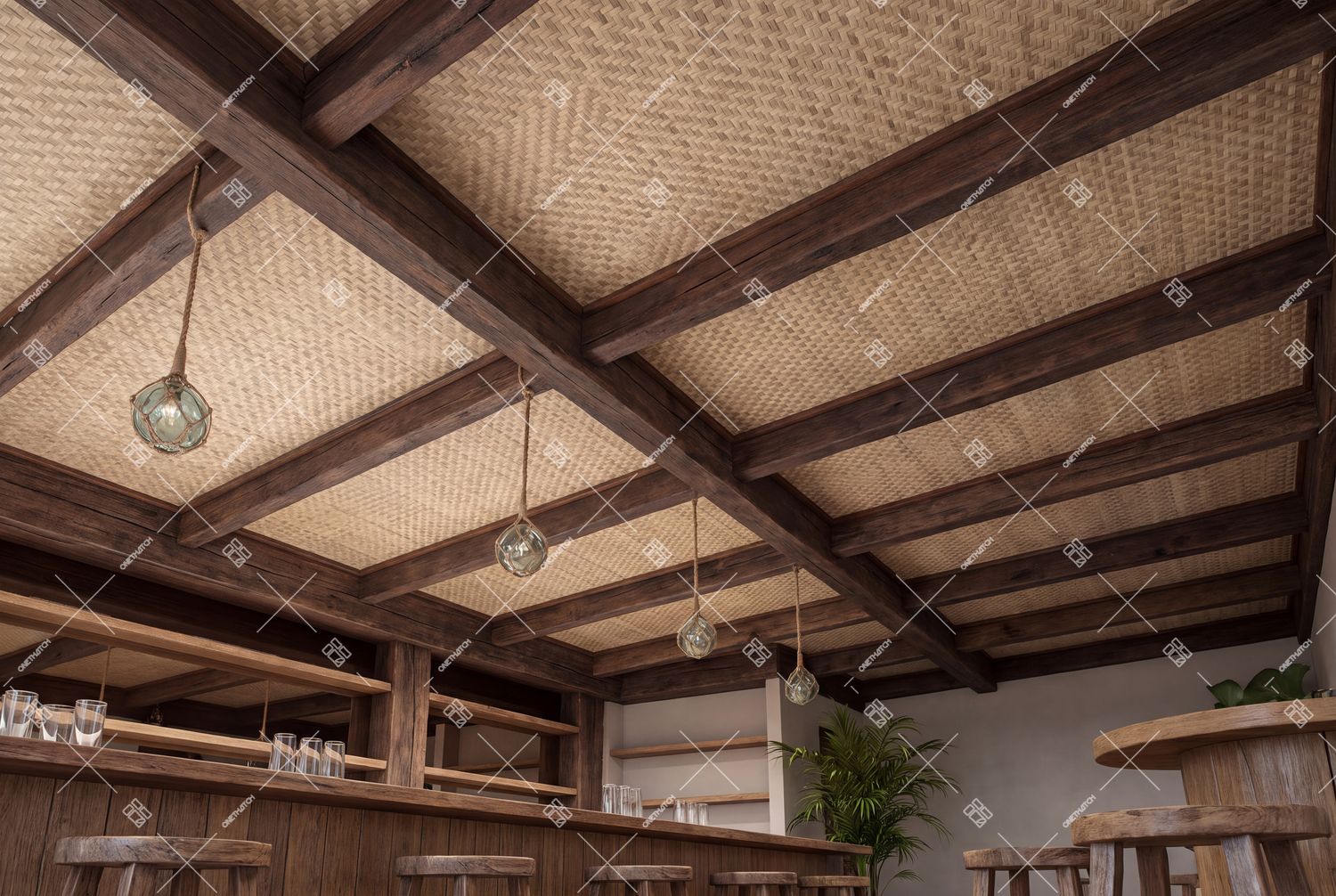
Use it on walls, ceilings, bar fronts and vertical furniture faces; never on floors or countertops.
Class A fire rated bamboo woven panels. Many specifiers want class a fire rated bamboo woven panels: mat already laminated to a board, ready to fix. The method is simple. Glue the FR mat to plywood, then fix the board to the ceiling or wall, using staples only, never nails. Ask your code consultant whether the backing board must also be fire-retardant-treated for your occupancy. Step-by-step help is in our installation guide.
Natural Mats with Fire Retardant vs the FR Woven Mat
Natural tropical weaves can be treated, and many sellers offer them that way. Here is how they compare:
| Natural mats treated after weaving | ONETHATCH FR Woven Mat | |
|---|---|---|
| Examples | Bac bac matting with fire retardant; lauhala matting with fire retardant; a cabana wall covering with fire retardant spray | Hand-woven HDPE, FR version to order |
| Where the protection sits | On the surface of the fibre | Part of the FR product as supplied and tested |
| Effect of cleaning, humidity and age | A coating can wear or wash off; check the maker’s re-treatment instructions | Nothing to reapply on site |
| Test evidence to ask for | Standard, lab, report number, substrate and whether it applies after weathering | ASTM E84 Class A and NFPA 286, confirmed with your quote |
| Moisture and mould | Natural fibre absorbs moisture | HDPE does not absorb water |
About fire retardant lauhala matting class a listings. If you see fire retardant lauhala matting class a offered, ask for the standard, the lab and the report number behind it, which substrate was tested, and whether the result still holds after the coating ages.
About Thatch Safe and other sealants. Topical fire-retardant sealants, Thatch Safe being one name buyers search for, are made to be applied to natural thatch and fibres on site. Their performance depends on full coverage and on following the maker’s reapplication schedule. A factory-made FR product removes that ongoing task from your maintenance team.
FAQ
Is bamboo flame resistant?
No, natural bamboo is combustible and is not flame resistant on its own. For a woven bamboo look with a fire rating, specify the FR version of the ONETHATCH Woven Mat, tested to ASTM E84 (Class A) and NFPA 286.
Is the standard Woven Mat fire rated?
No. The standard version has no fire rating. The Class A FR version is a separate, made-to-order product.
Which test does my inspector want, ASTM E84 or NFPA 286?
It depends on your code, occupancy and location; ASTM E84 Class A is the most common requirement, and NFPA 286 is often accepted as an alternative route for wall and ceiling finishes. The FR Woven Mat is rated to both, and we will confirm the standards and results so your consultant can choose.
Can I use FR matting outdoors?
Yes, in covered outdoor areas only, such as cabanas, verandas and palapas with a roof overhead. It is not for direct rain, floors or countertops.
Do you supply samples of the FR version?
Yes. Free samples are available on every ONETHATCH line, and our team can prepare a quantity take-off from your drawings.
Planning a restaurant, hotel or beach club ceiling? Send us your drawings and we will prepare a quantity take-off, the tested standards for your submittal, and free samples of the FR Woven Mat.
 7 reasons to choose synthetic palm thatch
 Kenninji-Gaki, the classic Japanese bamboo fence
 How to install ONETHATCH PALM (NIPA), step by step
 English
 Japanese
 Arabic
 Spanish
 French
 Portuguese
 Italian
 German
 Chinese (China)
 Thai
 Vietnamese
 Indonesian
 Korean
 Chinese (Taiwan)
 Russian