


Look up in a fine tea room, and the ceiling is woven.
Ajiro (網代) is the Japanese craft of weaving thin strips of wood, bamboo or bark into panels. For centuries it has crowned tea rooms, sukiya-style houses, ryokan and refined restaurants with a quiet, handmade texture. This guide explains the classic ajiro patterns, the traditional materials, how an ajiro ceiling differs from a batten-and-board ceiling, and how ONETHATCH synthetic woven sheet brings the look to restaurants and tatami rooms that need it to last.
What Is an Ajiro Ceiling?
An ajiro ceiling (網代天井) is a ceiling finished with woven ajiro panels instead of flat boards. It is softer and more textured than the most common traditional Japanese ceiling, the saobuchi ceiling (竿縁天井), where flat boards rest on slim parallel battens.
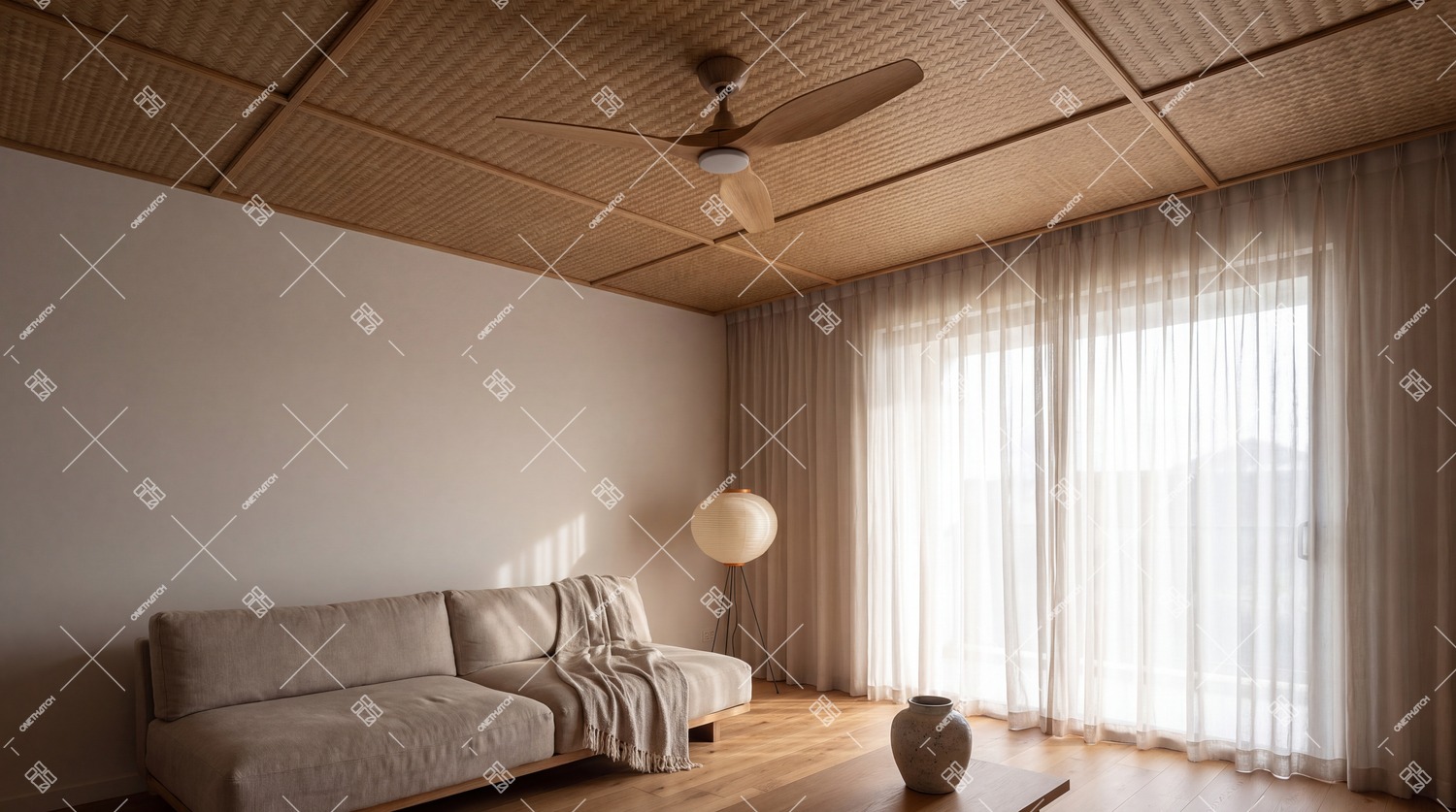
Designers often combine the two: a woven ajiro field in the centre, framed by battens, or an ajiro section stepped down above the tokonoma or the host’s seat in a tea room. The weave signals craft and intimacy; the battens give order.
The Three Classic Ajiro Patterns
Yabane ajiro (矢羽根網代): the arrow-feather weave
Strips meet in a V, like the fletching on an arrow, and repeat in rows of chevrons. It reads as lively and directional, and it is a favourite for corridors and long counters where the pattern can lead the eye.
Ichimatsu ajiro (市松網代): the checkerboard weave
Blocks of strips alternate direction, square by square, like a checkerboard. Laid square-on (正市松) it is calm and formal; turned 45 degrees (斜市松) it feels more dynamic. It suits tatami rooms and dining rooms where a restful, even texture is wanted.
Ishidatami ajiro (石畳網代): the stone-paving weave
Larger blocks set like paving stones in a garden path. It is bolder in scale and works beautifully on large ceilings, where finer weaves can disappear.
Many other ajiro patterns exist, from wave weaves to basket weaves. These three are the ones customers ask for most.
Traditional Ajiro Materials
- Akita cedar, straight grain (秋田杉柾): prized for its fine, even grain and soft colour; the classic for high-end ajiro boards.
- White-flesh bamboo ajiro (竹白身網代): the pale inner layer of bamboo, refined and bright.
- Bamboo-skin ajiro (竹皮ハダ網代): the outer skin of bamboo, glossier and darker, with a rustic, characterful look.
- Cypress, sawara and bark strips are also used.
Most natural ajiro is sold as ready-made ajiro ceiling boards (網代天井板), woven by hand onto a backing in traditional sizes such as 3 × 6 shaku (about 910 × 1820 mm). Fine hand-woven boards are a considerable investment, which is one more reason to protect them from damp rooms and busy service areas.
Each is beautiful. Each is also a natural material, with the limits that come with it.
Natural Ajiro vs ONETHATCH Synthetic Woven Sheet
Natural ajiro moves with humidity, can warp or lift, darkens and yellows over time, and can mould in damp rooms or attract insects. It is also handmade by a shrinking number of craftspeople, which makes repairs and matching new panels harder.
ONETHATCH Woven Mat is a hand-woven sheet of HDPE synthetic wicker in 13 mm strands. It keeps the handmade texture and drops those worries.
| Natural ajiro (cedar or bamboo) | ONETHATCH Woven Mat | |
|---|---|---|
| Material | Thin strips of wood, bamboo or bark | Hand-woven HDPE synthetic wicker, 13 mm strands |
| Colour over time | Darkens and yellows | No significant colour change after 5,000 h ASTM G155 accelerated weathering |
| Humidity | Can warp, lift or mould | No plant fibre for mould or insects to feed on |
| Fire | Combustible | Standard mat has no fire rating; Class A FR version (ASTM E84 + NFPA 286) to order |
| Where | Indoors | Indoors and covered outdoor areas (e.g. under deep eaves) |
| Warranty | – | 20-year limited warranty |
| Sheet size | Varies by maker | 1.22 × 2.44 m (4 × 8 ft); rolls 1220 mm × 50 m for large projects |
Pattern: the standard Woven Mat is woven in a diagonal zigzag, closest in feel to yabane ajiro. For larger projects we can develop other weaves to match a design, such as an ichimatsu or ishidatami look; send us a photo of the pattern you want.
Note for Japanese projects: the FR version is tested to US standards (ASTM E84, NFPA 286). Japan’s interior-finish restrictions (内装制限) use Japan’s own non-combustible and quasi-non-combustible certifications, which ONETHATCH does not claim. Check the requirement for your project with your architect.
Printed ajiro wallpaper
Ajiro-look bamboo-weave wallpaper (網代編み風 竹編み調 壁紙) is quick and economical, but it is a print. Up close there is no depth and no shadow between the strips. A woven sheet gives the real texture.
Where to Use It: Restaurants, Shops and Tatami Rooms
- Japanese restaurants worldwide. Sushi counters, kappo, izakaya and ramen shops: a woven ceiling over the counter sets the scene in seconds. For restaurant ceilings, specify the FR version where your code requires a rated finish.
- Ryokan, hotels and spas. Guest-room ceilings, lounges and corridors.
- Tatami rooms and tea rooms at home. A woven ceiling field, framed with battens.
- Tokonoma ceilings and alcoves. The tokonoma ceiling (床の間天井) is a traditional home for ajiro; a small woven panel above the alcove, or over a shoin-style desk niche, adds intimacy.
- Counter fronts and wainscot. Vertical faces only; never countertops or floors.
- Covered entrances. Under deep eaves or a covered porch, out of direct rain.
How to Install
- Cut plywood to panel size.
- Glue the Woven Mat to the plywood and secure the edges with staples (staples only, never nails).
- Fix the faced boards to the ceiling frame or wall.
- Lay ONETHATCH half-round bamboo poles across the joins as battens. The result recalls the classic ajiro field framed by saobuchi battens.
Teak and Carbonized are held in stock; Walnut, Ebony and Golden Oak are made to order.
FAQ
What is an ajiro ceiling?
An ajiro ceiling is a Japanese ceiling finished with woven panels of thin wood, bamboo or bark strips. It is found in tea rooms, sukiya-style buildings, ryokan and fine Japanese restaurants.
How is natural ajiro different from a synthetic woven sheet?
Natural ajiro is plant material that darkens and can warp or mould with humidity; ONETHATCH Woven Mat is hand-woven HDPE that keeps its colour and gives mould nothing to feed on. Both give a handmade woven texture.
Can I use it in a restaurant or a tatami room?
Yes. It suits restaurant ceilings, counter fronts and tatami-room ceilings indoors, and covered outdoor areas. For restaurants, choose the fire-retardant version where a rated finish is required.
Can I use it outdoors?
Only in covered areas, such as under deep eaves or a covered porch, out of direct rain.
Can it go on a countertop or floor?
No. It is for ceilings, walls and vertical faces only.
Bring Ajiro Craft into Your Space
The quiet beauty of a woven ceiling, made to last in a busy restaurant or a family tatami room. Explore the ONETHATCH woven ajiro sheet, see our guide to Japanese bamboo fence styles, and request free samples.
 7 reasons to choose synthetic palm thatch
 Kenninji-Gaki, the classic Japanese bamboo fence
 How to install ONETHATCH PALM (NIPA), step by step
 English
 Japanese
 Arabic
 Spanish
 French
 Portuguese
 Italian
 German
 Chinese (China)
 Thai
 Vietnamese
 Indonesian
 Korean
 Chinese (Taiwan)
 Russian