


Walk into a great tiki bar or island resort and look up. Chances are the ceiling is woven. Yet the types of tropical matting behind that look are very different: lauhala from the hala tree, bac bac from banana bark, rattan, seagrass, a dozen bamboo crafts, and now synthetic mats built for commercial life.
This guide gives you the vocabulary, shows how natural mats really hold up, and explains when a synthetic alternative to lauhala matting is the smarter choice.
Types of Tropical Matting at a Glance
One line per weave. These are traditional and market names for comparison only; ONETHATCH does not sell natural mats.
| Weave | Made from | Good to know |
|---|---|---|
| Lauhala mats | Hala palm leaves (pandanus) | The classic Pacific weave. Lauhala kilipaki is a prized soft-leaf variety; edges are finished with hala palm braid |
| Bac bac multi colored tropical matting | Banana tree bark | Bold, multi-tone strips, trimmed with bac bac braid |
| Abaca cloth matting | Abaca fibre, also called Manila silk | Abaca cloth is a loose, burlap-like weave of banana-family fibre |
| Lampac matting | Reed grass strips | Light, coarse and rustic |
| Rattan matting | Split rattan peel | Rattan cane webbing is the open weave seen on chair backs |
| Braided seagrass matting | Seagrass | Sea grass braid and braided seagrass also serve as trims |
| Sennit rope | Coconut husk fibre | The classic lashing and trim rope on tiki builds |
| Palm matting | Palm leaf | Simple, rustic, widely woven across the tropics |
| Bamboo reed matting | Thin whole reeds strung side by side | Light screens and ceilings |
| Guadua bamboo mats | Flattened Guadua culms | A staple of South American walls |
| Young bamboo skin weaves | Young bamboo skin | Smooth, pale and fine |
| Bamboo dhari (also bamboo dari, bamboo dhaari dari) | Split bamboo, North-East India | Weaved bamboo mats for floors and walls |
| Sheetal pati | Split murta cane, Bengal and Assam | A fine mat that stays cool to the touch |
| Anyaman bertam | Bertam palm leaf, Malaysia | Traditional wall and roof weaving |
| Ajiro | Bamboo, cedar or bark wickerwork, Japan | Ajiro weaving dresses tea-house ceilings |
| Amakan and sawali | Woven split bamboo, Philippines | The classic Filipino ceiling weaves |
| Bamboo mat board | Woven bamboo mats pressed with resin | A plywood substitute used for bamboo mat board wall panelling; a bamboo mat veneer composite adds a face veneer |
| Artificial pandanus matting | Plastic strips imitating lauhala | Quality and polymer vary widely |
| Bamboo peel and stick wallpaper | Printed vinyl or paper | A photo of a weave: flat to the touch |
| ONETHATCH Woven Mat | Hand-woven HDPE, 13 mm strands | Made for commercial walls and ceilings |
What Is Lauhala?
What is lauhala?
Lauhala is the dried leaf of the hala tree (Pandanus tectorius) and the weaving made from it. It is the signature material of Hawaiian and Pacific Island mats, hats and baskets.
What is lauhala in English?
In English, lauhala simply means “hala leaf”: lau is Hawaiian for leaf, and hala is the pandanus tree. You will also see it called pandanus weaving.
What is lauhala made of?
Natural lauhala material is the leaf itself, often sold as hala palm leaves, although pandanus is not a true palm. Leaves are harvested, de-thorned, softened, dried and cut into even strips.
What is a lauhala mat?
A lauhala mat is a flat mat plaited from those strips. Traditionally it covered floors and beds; today it is glued to walls and ceilings as a lauhala wall covering.
What is lauhala weaving?
It is the craft of plaiting strips over and under, often in a checkered pattern, by hand. Lauhala matting Hawaii history: in old Hawaii, lauhala mats covered floors and sleeping areas, and pandanus was woven into sails across Polynesia. Families still pass the skill down today.
Weave Patterns: Closed, Open, Basket and Herringbone
- Closed weave vs open weave. A closed weave has no gaps and covers a surface completely. An open weave leaves gaps that let light and air through.
- Checkered pattern. The classic lauhala and bac bac look: strips cross at right angles.
- Basket weave pattern. Pairs of strands pass over and under together. Basketweave matting reads calm and even; a basket weave suits large ceilings.
- Herringbone pattern. Strands step diagonally to form a V. A herringbone weave and other diagonal zigzag patterns add movement to a feature wall.
- Yabane. The Japanese arrow-feather pattern, a form of ajiro weave, prized in ajiro tenjo ceilings.
- Single or double. Single weave bamboo matting is one layer; lauhala matting double weave plies two layers for a thicker, sturdier mat.
- Two-tone and brushed finishes. A two-tone woven mat uses two colours to draw the pattern; a brushed artificial bamboo woven mat has a napped surface. A generic synthetic bamboo basketweave mat can look similar to these in photos, so ask for strand width, polymer and weathering data.
The ONETHATCH Woven Mat is hand-woven in a diagonal zigzag, a lively herringbone-style pattern that catches the light across a ceiling or feature wall.
Ajiro tenjo (網代天井) is the Japanese tea-room ceiling of boards faced with ajiro wickerwork.
Sheets, Rolls and Lauhala Wall Coverings
Natural mats come in plywood-friendly sizes. Most lauhala matting 4′ x 8′ sheets match a standard board, and bac bac matting 4′ x 8′ follows the same format. Rolls such as lauhala matting 3′ x 50′ cover long runs; listings also say lauhala matting 4×8 and lauhala matting 4 x 50.
Cabana matting is the trade name for these sheets and rolls used on walls, ceilings and bar fronts. A cabana mat in fine weave lauhala matting looks refined; a cabana fine weaving matting roll or lauhala weave matting roll suits long ceilings. Lauhala cabana matting is the classic choice; lauhala weave matting in a heavier plait suits rustic bars.
Woven or printed? A lauhala matting wall covering is real weaving. Lauhala wallpaper, lauhala mat wallpaper and lauhala weave wallpaper are prints: easy to hang, but flat in the light and close up.
The synthetic version comes in the same two formats: 1.22 × 2.44 m (4 × 8 ft) sheets, and 1220 mm × 50 m rolls for large projects.
Synthetic vs. Natural Matting: How They Hold Up
Natural mats are beautiful, and in a dry, quiet interior they can serve for years. Commercial spaces ask more of them. Here is synthetic vs natural matting, side by side:
| Natural mats (lauhala, bac bac, rattan, seagrass, bamboo) | ONETHATCH Woven Mat | |
|---|---|---|
| Dry interiors | Good | Excellent |
| Humid rooms, coastal air | Absorbs moisture; can mould and sag | HDPE does not absorb water |
| Covered outdoor areas | Fades and dries out; usually replaced every few years | Made for it: 5,000 h ASTM G155, no significant colour change |
| Insects | Natural fibre can attract pests | Nothing for pests to eat |
| Fire | Combustible; treatments are topical | Class A FR version to order (ASTM E84 and NFPA 286) |
| Warranty | Rarely offered | 20-year limited warranty |
Reading reviews? Whether you browse woven bamboo wall covering reviews, artificial bamboo matting reviews or bamboo matting uk reviews, look past photos taken on install day. Ask how the wall looked after a humid summer, a year of sun or a deep clean.
The Synthetic Alternative to Lauhala Matting
Our Woven Mat gives you the hand-woven look of tropical matting, made to survive commercial life. It is hand-woven from HDPE synthetic wicker in 13 mm strands, with UV stabilisers selected together with BASF stabilizer engineers. It is our own woven design, not a copy of any traditional weave. Learn more in What Is Synthetic Bamboo Matting Made Of?
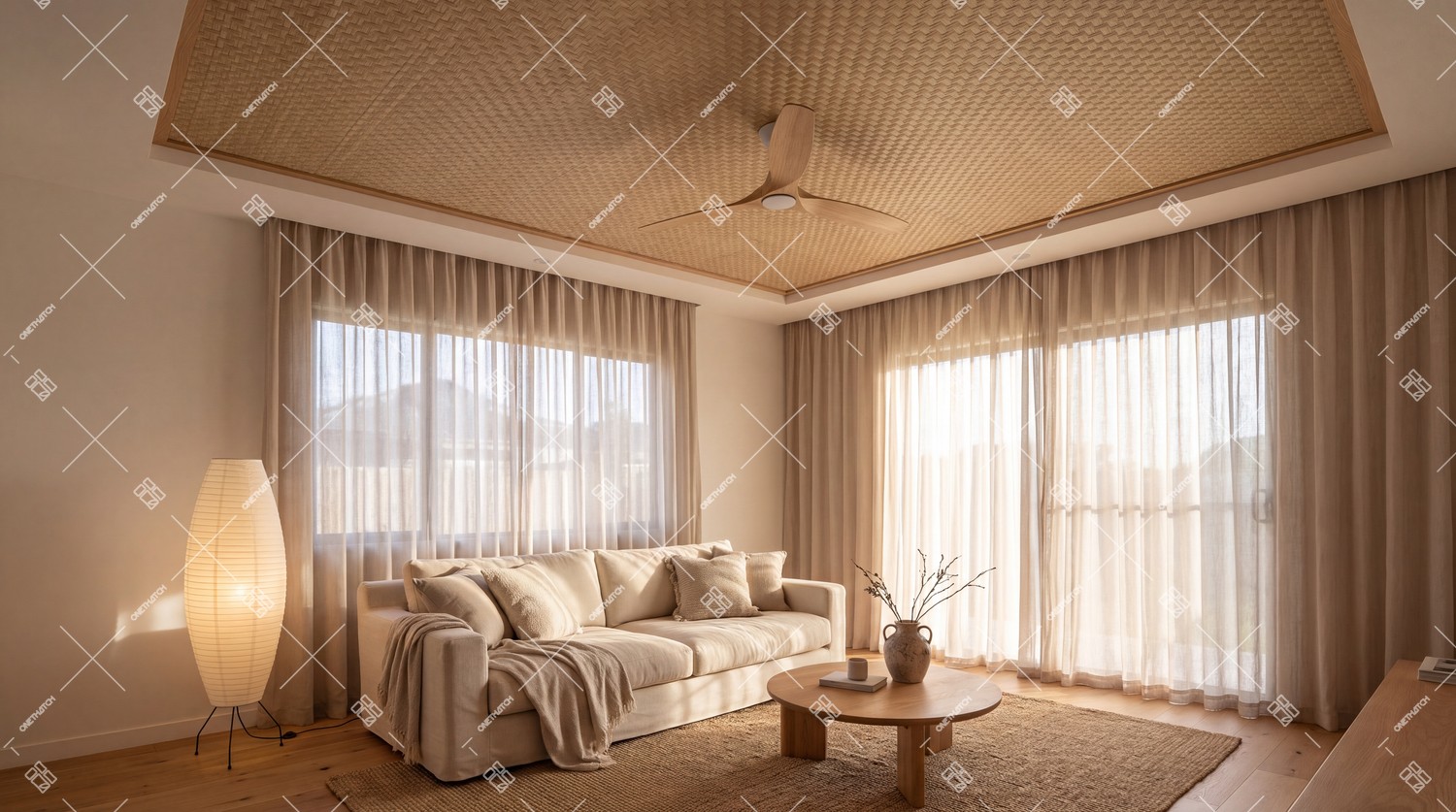
Synthetic bamboo mat benefits:
- The look stays. 5,000 hours of ASTM G155 accelerated weathering with no significant colour change (Micom MI-25-17428-1).
- No mould, no pests. HDPE gives moisture and insects nothing to work with.
- Fire option. A Class A FR version, tested to ASTM E84 and NFPA 286, made to order. The standard version has no fire rating. See fire-rated bamboo matting.
- Peace of mind. 20-year limited warranty, ISO 9001-certified production since 2010.
- Ready now. Teak is stocked, with Carbonized also in stock.
A synthetic alternative to lauhala matting for outdoor tiki bar builds. Under the roof of an outdoor tiki bar, the mat dresses bar fronts, back walls and ceilings through salt air and humid nights; our tiki bar construction guide walks through every surface. At Kuda Rah Resort in the Maldives, ONETHATCH matting works alongside our PALM (NIPA) synthetic thatch.
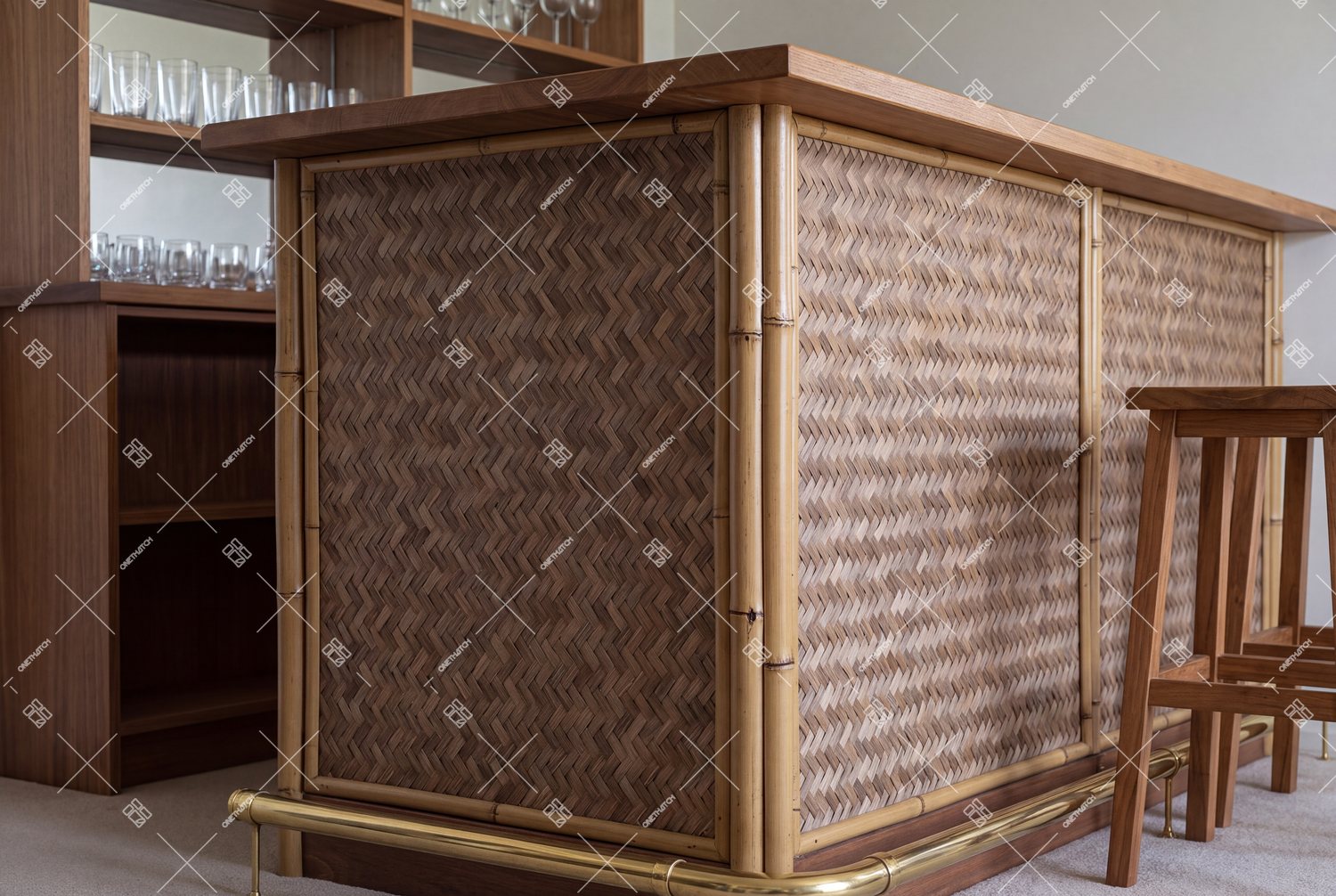
Where it does not go: floors, countertops, or anywhere open to direct rain. It is for indoor and covered outdoor walls, ceilings, bar fronts and vertical furniture faces.
Best Synthetic Bamboo Matting for Resort Ceilings: What to Check
The best synthetic bamboo matting for resort ceilings is the one that still looks right long after opening night. Before you choose, ask every supplier:
- Which polymer? Look for PVC-free HDPE with no mineral filler.
- Which weathering test? Ask for the named standard and the result, such as ASTM G155.
- Is there an FR version? Check for named ASTM E84 Class A and NFPA 286 results.
- What warranty? Ours is a 20-year limited warranty.
- Sheets and rolls? Rolls cut seams on large ceilings.
- Free samples? See and touch it before you commit.
Explore the full range of synthetic bamboo matting and our matting for ceilings.
How to Install Lauhala Cabana Matting (and the Synthetic Version)
How to install lauhala cabana matting: let the mat acclimatise to the room, fix it to a plywood backing with adhesive and staples, then cover seams and edges with trim such as hala palm braid, bamboo or sennit rope.
The ONETHATCH Woven Mat installs the same clean way: glue the mat to plywood, then fix the board to the wall or ceiling. Use staples only, never nails. Full steps in our installation guide.
Buying Natural? Questions for Suppliers
Looking for lauhala mats for sale, lauhala mats hawaii suppliers or natural bamboo mat suppliers for a home project? Ask about origin, pest treatment and fumigation for import, and whether any fire treatment is backed by a named standard, lab and report number. Natural weaving is a living craft and worth supporting where it fits.
FAQ
Which type of tropical matting is best for me?
For dry home interiors, natural lauhala, rattan or seagrass is a beautiful choice; for restaurants, resorts, humid rooms and covered outdoor areas, a synthetic woven mat is the better fit. Choose by where the mat will live, not only by how it looks on day one.
Why choose synthetic bamboo over natural bamboo?
Synthetic bamboo keeps its colour and shape where natural bamboo fades, absorbs moisture or attracts pests. The ONETHATCH Woven Mat adds a Class A FR option and a 20-year limited warranty, so the look you open with is the look you keep.
Is the ONETHATCH Woven Mat a lauhala or bac bac style?
No. It is our own hand-woven HDPE mat. Traditional names in this guide are for comparison only.
Can the synthetic mat be used outdoors?
Yes, in covered outdoor areas only, such as verandas, cabanas and palapas with a roof overhead. Keep it out of direct rain and off floors and countertops.
See the difference for yourself. Ask for free samples of the ONETHATCH Woven Mat, and send your drawings for a quantity take-off.
 7 reasons to choose synthetic palm thatch
 Kenninji-Gaki, the classic Japanese bamboo fence
 How to install ONETHATCH PALM (NIPA), step by step
 English
 Japanese
 Arabic
 Spanish
 French
 Portuguese
 Italian
 German
 Chinese (China)
 Thai
 Vietnamese
 Indonesian
 Korean
 Chinese (Taiwan)
 Russian