

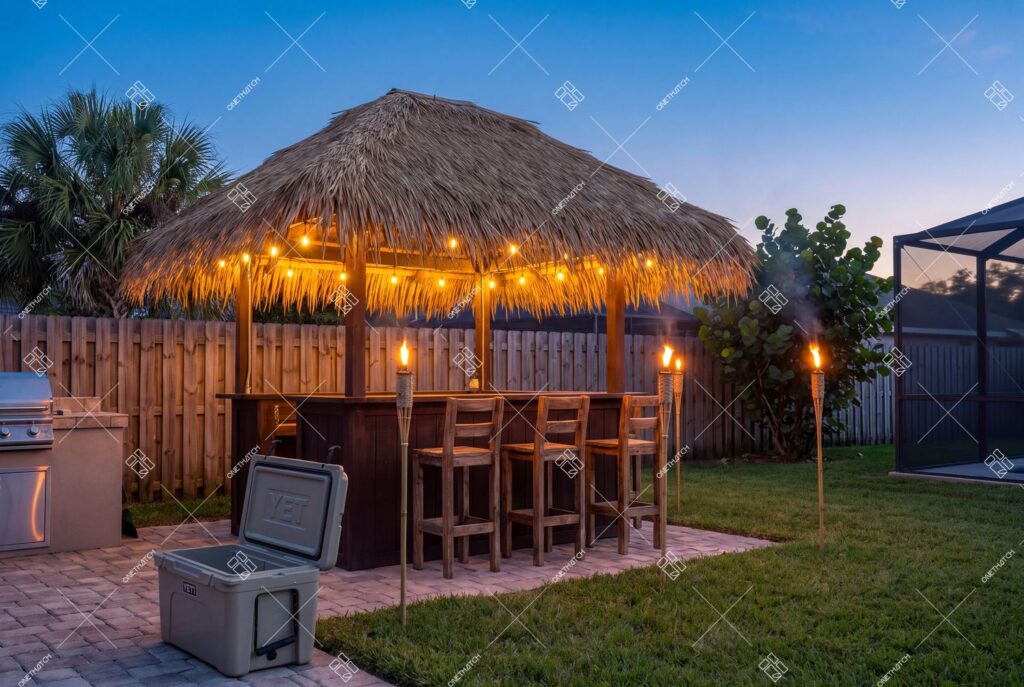
Quick answer: A tiki hut is an open-sided shelter with a thatched roof on wooden or bamboo-look posts, built for bars, pools and gardens. The low-maintenance way to build one is a synthetic palm thatch roof with synthetic bamboo poles, matting and panels: no re-thatching every few years, and no rot or pests. ONETHATCH supplies the whole set of materials, and the thatch, poles, matting and panels each carry a 20-year limited warranty.
Island time, at home or at your resort
Nothing turns a corner of a garden or a pool deck into a holiday faster than a tiki hut. The thatch overhead, the bamboo under your hand, the glow of torches at dusk: a tiki hut is a mood you can build.
This guide covers the types of tiki huts, what each part is made of, how to plan one and how to keep it looking new with almost no upkeep.
Types of tiki huts
| Type | What it is | Typical use |
|---|---|---|
| Tiki bar hut | A thatched roof over a bar counter | Backyards, pool bars, beach clubs |
| Pool or beach tiki hut | An open shade hut | Resorts, hotel pools |
| Tiki gazebo | A larger square or hexagonal structure | Gardens, events |
| Tiki umbrella | A single pole with a thatched canopy | Pool decks, patios, beaches |
| Themed tiki hut | Restaurant and attraction buildings | Theme parks, zoos, waterparks |
What a tiki hut is made of
Every tiki hut has the same few parts. Here is the traditional material for each, and the low-maintenance version.
| Part | Traditional | Low-maintenance ONETHATCH choice |
|---|---|---|
| Roof | Natural palm, re-thatched every few years | PALM (NIPA), STRAW (BALI) or REED synthetic thatch |
| Posts and trim | Natural bamboo or logs | Synthetic bamboo poles, over a galvanised steel post where they carry load |
| Bar front and walls | Natural matting or reed | Woven Mat or bamboo panels |
| Ceiling | Natural matting | Woven Mat ceiling (covered areas) |
| Lighting | Torches | ONETHATCH bamboo torches |
More on each part: tiki hut roof · tiki bar walls, ceilings and bar fronts.
Why build your tiki hut synthetic
- No re-thatching cycle. Natural palm needs re-thatching every few years. ONETHATCH thatch carries a 20-year limited warranty.
- No rot, no termites, no nesting birds. There is nothing for them to feed on.
- Wind tested. PALM (NIPA) passed ASTM D3161 at 160 mph (260 km/h) with no loss of attachment, and Florida TAS 100. This is a lab result, not a design wind speed for your site.
- Fire options. FR PALM and FR REED are rated ASTM E108 Class A, which matters for commercial bars. The standard versions carry no fire rating.
- Poles that last. ONETHATCH synthetic bamboo poles are moulded from real bamboo and don’t crack in heat or cold.
Planning your tiki hut
- Footprint and shape. Square, rectangular or hexagonal. Leave generous overhangs for shade.
- Structure. A timber or steel frame. Bamboo-look poles can clad steel posts.
- Roof style. Palm for the classic tiki look, straw for a Bali hut.
- Local rules. Ask your local building department about permits and fire requirements before you build, especially for a commercial bar.
- Materials list. Thatch panels plus ridge, poles, matting or panels, and fixings. To size the thatch, see how many thatch panels do I need?
Building the bar yourself? The full walls, ceiling and bar-front build is in our DIY tiki bar construction guide, and the roof goes on as shown in how to install synthetic palm thatch.
Caring for a synthetic tiki hut
Rinse the thatch with fresh water now and then, especially near the sea, and check the fixings once a year. That is all: no re-thatching and no sprays.
Common mistakes
- A roof pitch too flat for the thatch look. Ask us before you frame.
- Natural bamboo posts set straight into soil, where they rot. Use bamboo-look poles over steel.
- Ordering roof area as floor area. Pitch and overhang add surface.
- Forgetting the ridge cap and edge finish.
- Skipping the FR version for a commercial bar.
What to send us for a quote
- Footprint, shape and height.
- Roof pitch and roof style.
- The parts you need: roof, poles, bar front, ceiling.
- Whether you need the FR version.
- Location and timeline.
- A sketch or photos.
Request free samples and a quote →
Tiki hut FAQs
What is a tiki hut?
An open-sided shelter with a thatched roof on posts, used for bars, pools and gardens.
What is the best roof for a tiki hut?
For low maintenance, a synthetic palm thatch such as ONETHATCH PALM (NIPA): no re-thatching cycle, a 20-year limited warranty and a published wind test.
How long does a tiki hut roof last?
Natural palm needs re-thatching every few years. ONETHATCH synthetic thatch carries a 20-year limited warranty and has passed 5,000 hours of ASTM G155 accelerated weathering.
Can I build a tiki hut myself?
Yes. ONETHATCH PALM screws to open battens with no sub-deck, so a handy builder can install it.
Do I need a permit for a tiki hut?
It depends on your city, county and use. Check with your local building department before you build.
Is a synthetic tiki hut fire safe?
No thatch is fireproof. Choose FR PALM or FR REED, which are rated ASTM E108 Class A. The standard versions carry no fire rating.
What poles should I use for a tiki hut?
Synthetic bamboo poles. For posts that carry load, sleeve them over galvanised steel; the steel does the work and the bamboo gives the look.
What is the difference between a tiki hut and a palapa?
Both are thatched shade structures. “Palapa” is the Mexican name for a palm-roofed shelter, often round or conical, while “tiki hut” comes from Polynesian-themed bars. The materials are the same. See our Mexican thatched ramada guide.
Suggested guides: complete synthetic thatch guide · palm thatch for a tiki hut · synthetic bamboo poles · bamboo tiki torches
 7 reasons to choose synthetic palm thatch
 Kenninji-Gaki, the classic Japanese bamboo fence
 How to install ONETHATCH PALM (NIPA), step by step
 English
 Japanese
 Arabic
 Spanish
 French
 Portuguese
 Italian
 German
 Chinese (China)
 Thai
 Vietnamese
 Indonesian
 Korean
 Chinese (Taiwan)
 Russian