

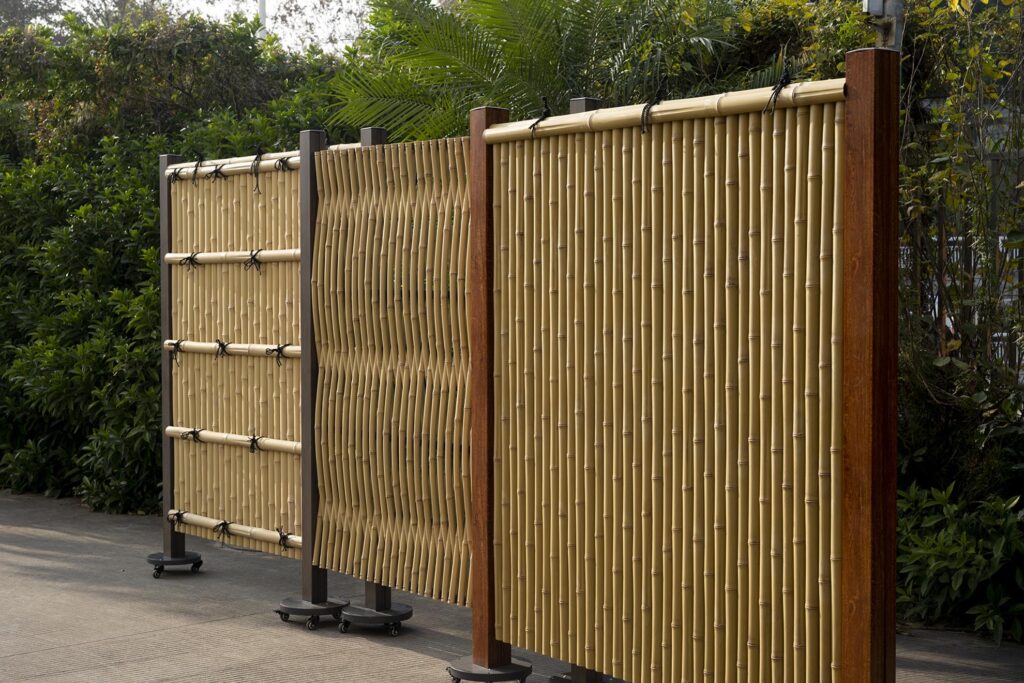
Bamboo as a material for fences
Bamboo has been used as a fencing material for centuries. It’s robust and easy to work with, making them very popular in Japanese zen gardens. In the past, bamboo fences were assembled as a simple string of bamboo poles. Then it was expanded into different colors, patterns, and designs significantly over time.
In recent years, bamboo fences have been used more and more as privacy screens to set property boundaries. But the natural bamboo fence will decay and lose its color in just a few years. Owners are left to repair and replace them, again and again.
That’s why we create synthetic alternatives. Artificial bamboo fences have become popular in recent years, as they are less susceptible to damage and weather influences and can be maintained with minimal effort.
Differences between natural and artificial bamboo fences
A rough distinction is its material. Natural bamboo fences are made of natural material, elaborately crafted with traditional designs by master artisans. Artificial bamboo fences are moulded from real bamboo in weather-resistant ASA resin, then set on powder-coated aluminum frames as lightweight panels for easy installation.
Bamboo Fences made of natural bamboo have a unique, typically tasteful texture and radiate their very own elegant atmosphere. On the other hand, the artificial bamboo fence stands up to rain, sun, heat and cold, and its color holds: it passed 5,000 hours of ASTM G155 accelerated weathering at Micom Laboratories (Canada) with no significant colour change. This also makes it easy to clean and suitable for outdoor use in all weather conditions.
Advantages and disadvantages of natural bamboo fences
Advantages
01. The natural bamboo fence gives the touch a vivid feeling of warmth, tradition, and craftsmanship.
02. You can perceive the scent of the bamboo appearance and feel the fine textures and enjoy the atmosphere of the natural calmness.
Disadvantages
01.Natural bamboo screens require regular care and ongoing maintenance. Otherwise, the natural bamboo will weather relatively quickly, and cracks and rot can occur with unsightly discoloration in the wood.
Advantages and disadvantages of synthetic bamboo fences
Advantages
01. Long-lasting, durable and easy to care for: no sealing, staining or pest treatments, just an occasional rinse with water and mild soap. The synthetic bamboo products are crafted from high-quality, weather-resistant resins.
02. Many of the designs are so detailed and realistic that they can hardly be distinguished from natural bamboo, making them additionally suitable for numerous applications. Ten Japanese garden styles in our standard Sundried color, customized to your layout, allow a high degree of flexibility in design.
Disadvantages
01. Nothing synthetic carries the fresh scent of natural bamboo fences.
The gradual aging process of natural bamboo cannot be replicated. Instead, there is a choice of shades and finishes to suit different ages of the material.
02. Each material has its advantages and characteristics, but we recommend a low-maintenance fence made of artificial bamboo for private properties.
Interested in learning more about how long can synthetic bamboo fencing last? Follow the link to find out more, or request a quote for your next project.
 English
 Japanese
 Arabic
 Spanish
 French
 Portuguese
 Italian
 German
 Chinese (China)
 Thai
 Vietnamese
 Indonesian
 Korean
 Chinese (Taiwan)
 Russian